My company doesn't show up in ChatGPT
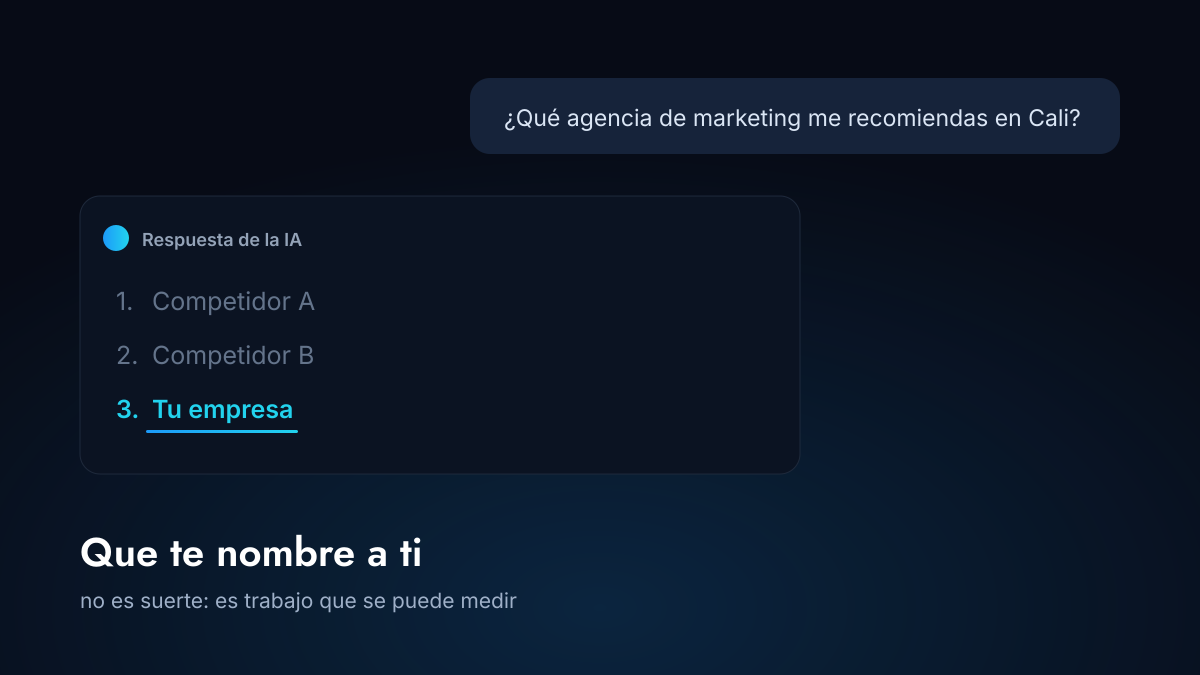
Someone opens ChatGPT in a meeting, asks about suppliers in the sector, and three competitors come up. It's almost never about size, and each of the three causes is checked and corrected differently.
It's a scene that already repeats in management meetings: someone opens ChatGPT in front of the team, asks about suppliers in the sector, and three competitors come up. Their own company, which has been doing good work for years, isn't mentioned. The good news is that this is almost never about size, and it's fixable.
The short answer: why ChatGPT doesn't recommend your company
Because it doesn't find enough signals about you outside your own site. AI doesn't consult a company directory: it builds the answer from what others published about you and from what your site says clearly. If your site shuts the door, doesn't answer specific questions, and nobody else mentions you, it has nothing to name you with.
First cause: your site doesn't let AI crawlers in
It's the most common and the easiest to fix. AI engines use their own crawlers —GPTBot is OpenAI's, and there's one for each engine— different from Google's. Many sites block them without knowing: it comes by default in the hosting, or a security plugin enabled it, or it was added to "save server resources".
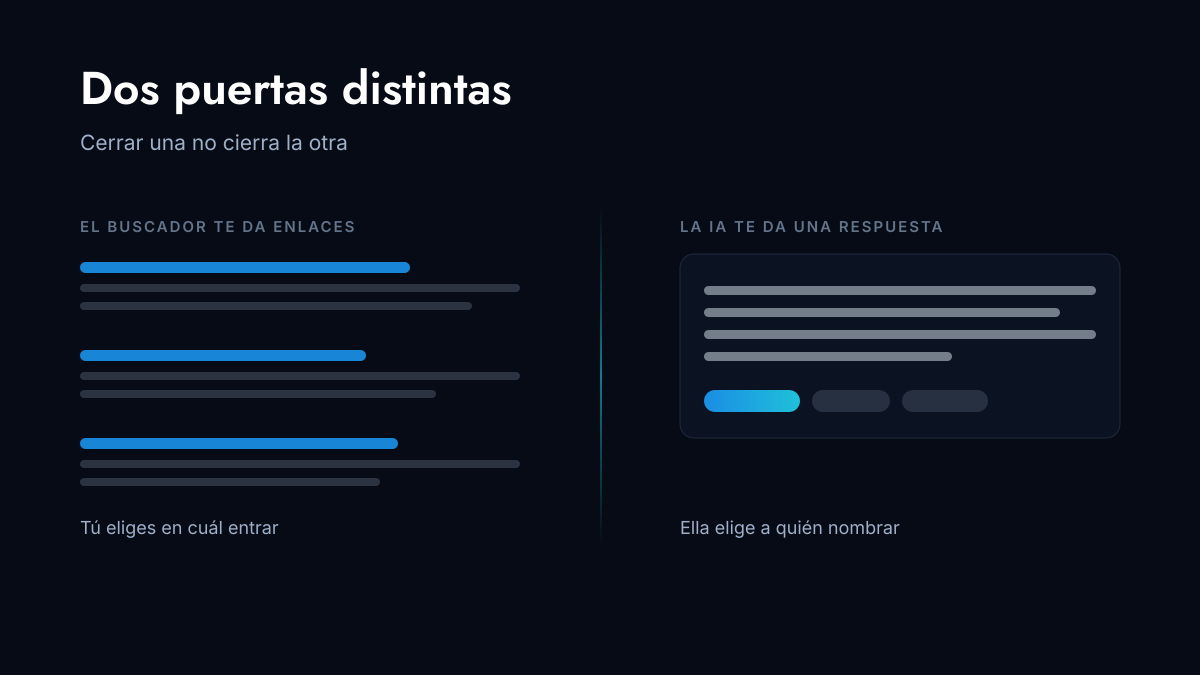
The result is that you can be perfectly ranked on Google and invisible to the more than 900 million people using ChatGPT every week. They're two different doors, and closing one doesn't close the other.
This is checked in minutes and corrected in an afternoon. It's always first: any other work is useless if the engine can't read the page.
Share by clicks each AI sends to websites · Statcounter, July 2026. Two engines account for nine out of ten queries, so measuring on only one leaves a good part of the market out.
Second cause: your site talks about you, it doesn't answer questions
Most corporate sites are written like a brochure: who we are, our mission, our services. That's information about the company, not answers to questions.
And AI answers questions. When someone types "I need a company to help me with X in Colombia, which one do you recommend?", the engine looks for pages that answer that question. A page saying "we are leaders in comprehensive solutions" answers nothing — it doesn't say who it's for, or where it operates, or what problem it solves.
The correction isn't writing more, it's writing differently: pages that answer a specific question from the first paragraph, with verifiable data. A paragraph of 40 to 60 words that answers directly is worth more than two thousand words of context, because it's the unit the engine can extract and cite.
Third cause: nobody else is talking about you
This is the one that weighs most and takes longest. AI builds its answer from what others say about you: press, sector directories, associations, reviews, articles where you're mentioned. Your own site is a source, but it's the source with the least weight, because it's the interested party.
And in Colombia this runs faster than in the rest of the region: Microsoft places the country at the head of Latin America in artificial intelligence adoption. The more people ask, the more times that list of three names gets handed out. And since engines prefer to back what they recommend with a source that isn't you, without third-party mentions they have nothing to hold your name up with.
The order matters, and this is it
-
Open the door — days. That AI crawlers can get in, and checking the robots.txt file isn't enough: the block is usually in the firewall or in the content delivery network —Cloudflare, for example, has a switch that blocks AI crawlers and on some plans rewrites that file on its own— so the page looks perfect in the browser and the engine gets a door slammed in its face.
And there's a distinction that decides the outcome: not all crawlers do the same thing. Some collect material to train future models —GPTBot, ClaudeBot, Google-Extended—; others come in at the moment someone is asking, to fetch today's answer: OAI-SearchBot and ChatGPT-User on ChatGPT, PerplexityBot on Perplexity. To appear in this week's answers, the ones that can't be blocked are the second group. A related detail that confuses many people: blocking Google-Extended doesn't take you out of Google's AI summaries, because those are built from the regular search index.
There's one point almost nobody checks: if your page's text only appears after the browser runs code —the norm on sites built with JavaScript frameworks— the crawler sees an empty page, even with permission to enter. And a warning about the fashion of the moment: the llms.txt file, which some sell as the solution, isn't officially used by any engine today. None of this is verified by reading the configuration, it's verified in the server log: which crawler came in, what it asked for and what code the site responded with.
-
Answer questions — weeks. The unit of work isn't the article, it's the passage: a heading with the question exactly as a customer writes it and, right below, an answer of 40 to 60 words that stands on its own if pulled out of context — which is exactly what the engine does. Below that goes the long development, for whoever wants to read it.
That passage has to bring a verifiable fact —price, timeline, coverage, requirement, a figure with a source— because between two pages saying the same thing the engine cites the one it can attribute. And on top goes a layer that organizes the rest: structured data (Organization, Service, FAQPage) doesn't get you cited, but it tells the engine unambiguously who you are, what you sell and where you operate. That same thing is reinforced by something far more boring and far more effective: using the same name, the same address and the same phone number on your site, on your Google listing and in every directory you're in. When those details don't match, the engine doesn't know whether you're one company or three similar ones, and in doubt it doesn't name you.
-
Get mentions — months. Here's the fundamental difference from traditional SEO: it isn't only about links. A language model reads text, so a mention without a link —in a publication, in a sector report, in a third-party comparison— also counts, something that barely registered in classic search.
And you don't have to guess where to get them. When an engine answers, it cites its sources: the list of sites it used to name your competitors is the map of where you need to be. They're usually sector directories, trade associations, specialist press, comparisons and text reviews — not bought link packages, which also go against Google's policies and whose risk your domain carries.
The three steps aren't done and forgotten: they're measured again with the same questions every month. It's the only way to know whether what moved was your visibility or the model's mood, which changes too.
Doing it the other way round is the expensive mistake: investing in mentions and press while the site is still closed or mute is paying to bring people to a barred door. If you want to understand how the work is divided between search engines and AI engines, it's explained in the difference between SEO and GEO.
How to know where you stand
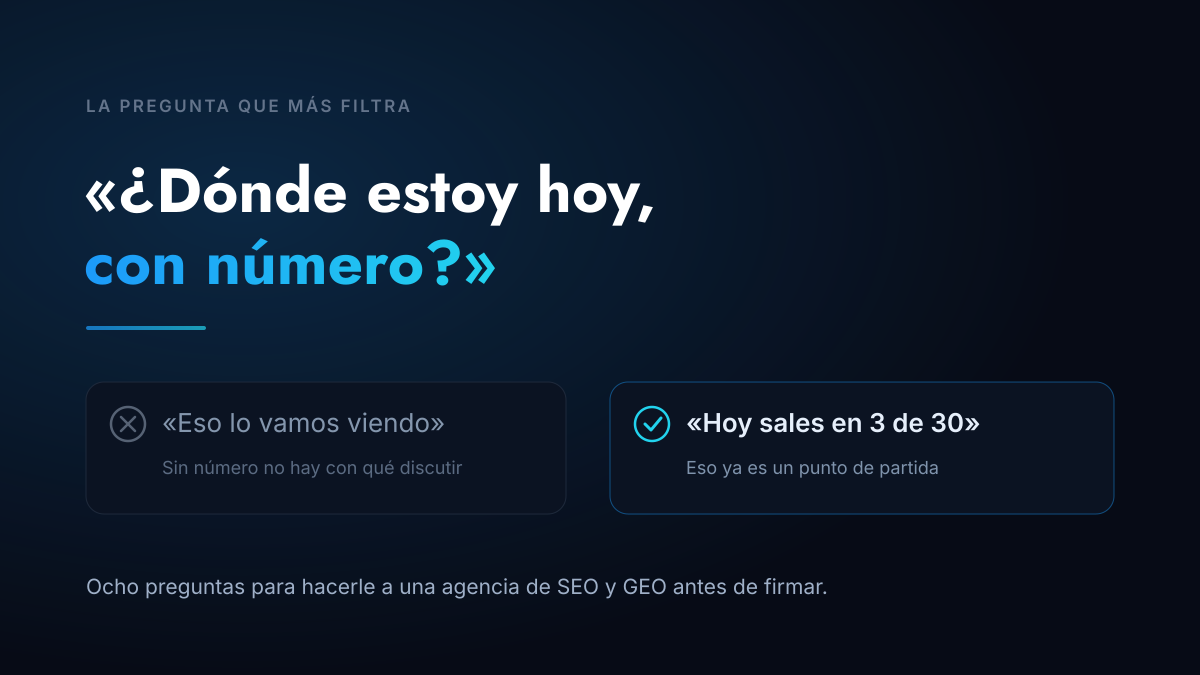
Before hiring anything, it's worth having the number: in how many of the questions people buy you for do you show up today. It isn't an impression, it's measured — the real questions are put to each engine and counted. That number is the only thing the following months' work can be compared against.
If you're going to hire someone for this, what to ask before signing has the eight questions that separate whoever knows how to do it from whoever improvises. And if you want that number right now, check for free whether AI recommends you.
This is the work we do in our AI visibility service, and always in that order: first we measure how many questions you appear in, then we open the door, and only then do we write.
Frequently asked questions
Why does AI recommend my competition and not me?
Almost always because it finds signals about them that it doesn't find about you: mentions on other sites, pages that answer specific questions, or simply a site it can read. It isn't a paid ranking or a closed list.
Can I pay OpenAI or Google to appear in the answers?
No. Today there's no way to buy a place inside a generative engine's answer. What does exist is advertising around it, which is a different thing and doesn't buy the recommendation.
How long does it take to change?
The work and the result have to be separated. The work: opening the door is done in days, rewriting the pages that matter takes weeks, mentions are earned over months. The result: the first sign is starting to appear in questions where you didn't before, and it usually arrives between month 2 and month 4. Anyone promising a change in 30 days is selling an expectation they don't control.
Does having lots of social media help?
They help little on their own: engines give them less weight than a mention in a publication or in a serious sector directory. They work as reinforcement, not as strategy.
Does AI name your brand?
Enter your domain and we tell you in seconds whether AI already recognizes your brand, and what your site is missing for the engines to read you.
Free, in seconds, no signup.