What SEO and GEO ranking costs in Colombia
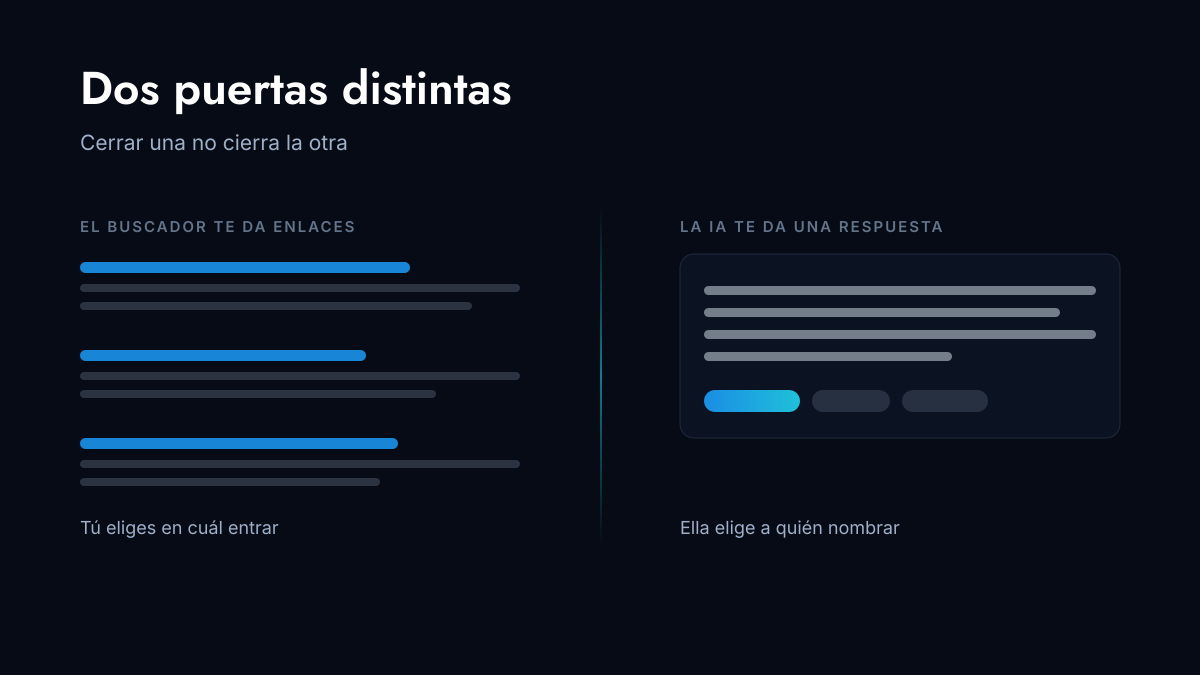
The honest answer has ranges, not a figure: the same service costs three times more or less depending on how many lines of business have to be worked and what state the site is in.
It's the question asked once the decision to invest has been made and the budget still has to be sized. The honest answer has ranges, not a figure: the same service costs three times more or three times less depending on how many lines of business have to be worked and what state the site is in.
The short answer: what SEO and GEO ranking costs in Colombia
For a services company, serious monthly SEO and AI visibility work in Colombia starts at around COP 2,500,000 a month and reaches COP 6,000,000 with several lines of business. Upwards there's no ceiling: with many brands or several countries, the figure multiplies. Below COP 1,000,000 what's usually being sold is an automated report and two posts a month.
Before looking at ranges it's worth knowing what you're going to buy. If it isn't yet clear to you why the work changed, it's explained in how SEO and GEO differ.
The three tiers of the market
| Monthly range | What it usually includes | Who it's for |
|---|---|---|
| Under COP 1,000,000 | Standardized or automated work: measurement, report and posts with no judgment of their own | Useful for starting to see the dashboard, not for competing for a position |
| COP 2,500,000 – 4,000,000 | One or two lines of business, new content, technical foundation, monthly measurement | Small services businesses with a clear focus |
| COP 4,000,000 and up | Several lines, external mentions, content and rewriting in parallel | Companies with several fronts or markets. No fixed ceiling: with many brands or countries, the budget multiplies |
Ranges observed in the Colombian services market in 2026, from proposals we've seen compete. They aren't published rates: almost no agency in the country publishes a price, and that's precisely part of the problem.
What moves the price
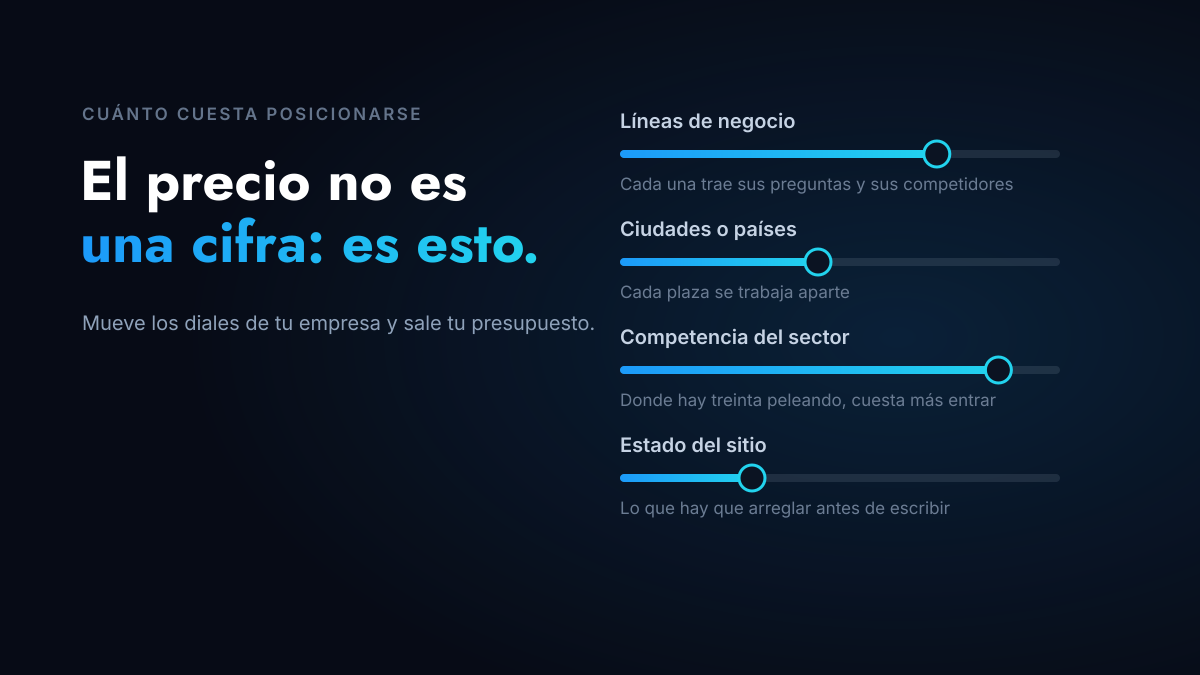
- How many lines of business. It's the heaviest factor. Ranking one service doesn't cost the same as ranking four: each has its own questions, its own competitors and its own content.
- The state of the site. A slow site, with no structure or blocking crawlers, needs fixing before any content pays off.
- Creating or rewriting. If articles already exist, rewriting is cheaper and faster than creating, and it keeps the URL's age. A large blog makes the work cheaper, not more expensive.
- External mentions. Getting others to talk about you is the slowest work and the one that raises the price most. It's also the one that weighs most in AI's answer.
- How contested your sector is. Entering where three competitors are working the topic doesn't cost the same as where there are thirty with years of content and press behind them. In highly contested sectors organic work takes longer to pay off, and the norm is to bridge the gap with paid media —quoted separately and usually the most expensive line of all. That cost isn't SEO's or GEO's, but it enters the same budget conversation and it's worth looking at together.
- How many cities or countries you want to appear in. Ranking in Cali doesn't cost the same as ranking in the country's five main cities, and that in turn doesn't resemble doing it in five countries. Each market brings its own competitors, its own local sources and, when several countries are involved, even a different way of asking. The work multiplies, it doesn't get shared out.
Why nobody can give you your figure over the phone
Our entry rates are published below, and any serious agency's should be. What can't be given without looking at the site is your number: how many lines come in, what has to be fixed before writing, in how many markets you want to compete. A closed figure given blind is one of two things —a number inflated to leave margin, or a low one to close the sale and cut the work later— and neither is useful to whoever is hiring.
Our rates, and why the diagnostic is paid
They're within those ranges and they're public: the Diagnostic costs COP 490,000 as a one-off payment, the monthly plan starts at COP 2,900,000 a month with a six-month term, and the wider-scope version at COP 4,500,000. We publish them because whoever asks the price is already deciding, and making them wait for a meeting to find out helps nobody. What's in each month, task by task, is in the detail of the monthly SEO and GEO plan.
The question that always follows is the same, and it's fair: why charge for a diagnostic that almost the whole market gives away? Because it isn't the same thing. A free diagnostic is a sales meeting: someone glances at your site, points out three improvable things and presents you with a proposal. The paid one is a measurement of your business: the questions your buyer would ask at each stage of their decision, per line of business put to the most used artificial intelligences, with web search active. From it you come away with this:
- Which buying questions you appear in and which you don't, split by line of business. It's the difference between "we're so-so in AI" and "in the service we want to grow we score zero". The average hides exactly that.
- Who appears in your place. The competitors AI does recommend when it doesn't name you. It's usually the uncomfortable part and the most useful.
- Where AI got what it said. It's the most actionable part of the report, because it tells you which sites you need to be on to get into that answer.
- What's holding your site back and in what order to fix it: what's a matter of days, what's months, and what isn't worth touching yet.
- A 90-day plan and a one-hour session with the team to go through it. The session is included: presenting your own proposal isn't charged separately.
- A repeatable starting point. In three months it's measured again with the same yardstick and you know whether you progressed. Without that, any later result is an opinion.
How the questions are chosen and weighted, and how the score is calculated, is ours and we don't publish it. The result is yours, complete and with the questions in plain sight.
Two more things, which are what take the risk away. If you then take the monthly plan, that COP 490,000 is credited against your first month: whoever ends up working with us doesn't pay for the measurement twice. And if you don't take it, the report is still useful to you —we say so before charging for it— because a diagnostic that only makes sense if you buy the plan isn't a diagnostic, it's a brochure.
One clarification companies outside our city usually ask for: this work doesn't depend on where you are. We operate from Cali for clients across the country and outside Colombia too — the measurement, the content and the mentions are done the same for a company in Bogotá, in Medellín or in Mexico City. What changes with geography isn't the way of working, it's the scope. The detail of the method is in how we work from Cali.
How to know whether it pays for itself
The calculation isn't made with visits, it's made with customers. If your average ticket is several million —which is normal in B2B services— a single new customer per quarter already covers the monthly fee.
And there's one figure that shifts that calculation in your favor: the visitor arriving from an AI converts far better than the traditional organic one. Semrush's study quantified it at about 4.4 times more value, because that person arrives with the comparison already done. Fewer visits, but better ones. It's why Bain keeps insisting that raw traffic stopped being the useful metric.
What order to spend in
The expensive mistake in this decision isn't picking the wrong tier. It's signing a monthly retainer before knowing where you stand. Without that figure the budget gets divided on intuition —or on whatever the agency does best— and six months later there's nothing to compare against: neither you nor they can say whether it worked.
The order that avoids that is simple:
- The number first. How many of the questions people buy you for do you appear in today, and who appears in your place. It's the step that makes everything that follows verifiable: every month's progress is measured against that number.
- Then the scope. With that figure in hand you decide how many lines of business come in, in which cities, and whether the site needs fixing before writing is worth it. That's where the range stops being a range and becomes your figure.
- The contract last. Demanding in writing the initial measurement, what gets done each month with a name on it, who does it and what happens to the content if you leave. The eight questions that separate whoever knows from whoever improvises are in what to ask before signing.
That first step is the diagnostic, and it goes first for a practical reason: it's what turns the range into your figure. How many lines come in, in how many markets you want to compete and how contested your sector is stop being guesswork questions and become variables with a number beside them. From there, the budget is decided like any other company investment: knowing what you're buying and what you're going to compare it against in three months.
Frequently asked questions
Why is there such a price difference between agencies?
Because different things are sold under the same name: a monthly automated report doesn't cost the same as rewriting pages, earning mentions and measuring across three AI engines. Ask for the detail of tasks and the difference explains itself.
What does a serious monthly plan include?
Initial and monthly measurement, technical work on the site, new or rewritten content with a defined objective, and management of external mentions. All with counted tasks, not with concepts.
Can I start with a smaller budget?
Yes, by starting with a single line of business instead of all of them. It's better to do one front properly than to split the same money across four and move none of them.
How long until it pays for itself?
In B2B services, with high tickets, one new customer per quarter is usually enough. The first sign isn't the sale but the appearance: starting to show up in questions where you didn't before.
Does the price include the ad spend?
No. The monthly fee covers the work —technical, content, mentions and measurement—; whatever is paid to Google, Meta or LinkedIn is separate and goes directly to the platform, not to us. It's worth being clear on when building the annual budget, because in highly contested sectors advertising is usually the larger of the two.
Does VAT get added to those prices?
Yes. The monthly plan and diagnostic rates are invoiced plus VAT. We say so up front because it's the surprise that causes the most discomfort when it appears on the first invoice and not in the proposal.
Is there a minimum term? What if I want to stop earlier?
The monthly plan has a six-month minimum, and the reason isn't commercial: the first months' work is what sustains the following months' result, so cutting it halfway wastes what has already been paid. What is yours no matter what is the content, the pages and the access. The diagnostic, by contrast, commits you to nothing.
Who writes the content and can we review it before publishing?
We write it and it always passes through you before publishing. It's a short review —half an hour a month is usually enough— but it isn't skipped: you're the one who knows the nuances of the business, and in professional services a technical inaccuracy costs more than a month of ranking.
Do you need access to my site? What if another supplier manages it?
We need to be able to publish and adjust the technical side. If another supplier runs your site, we can work by coordinating with them —we do it often— though there the pace depends on how fast a third party responds, and that's worth saying before fixing deadlines. The measurement accounts are always created in your name.
How do I verify the work I'm paying for was done?
With the monthly report, which should bring tasks with a name and a link —which page was rewritten, which article was published, which mention was earned— and the measurement figure beside them. If the report talks about "optimizations" and "continuous improvements" without saying on what, there's no way to audit it, and that's the point.
How long does the diagnostic take?
The report generates itself and you have it in under half an hour from approving the initial brief: the measurement runs without intervention. Then comes the human review of those results, which takes up to five working days and almost always less, and the one-hour session to go through it with you is scheduled by calendar.
Does AI name your brand?
Enter your domain and we tell you in seconds whether AI already recognizes your brand, and what your site is missing for the engines to read you.
Free, in seconds, no signup.