SEO or GEO: which one does your company need
Someone on the board read that AI is going to replace Google and the doubt appears about whether to keep paying for SEO. The answer is neither extreme, and the underlying change isn't the one being discussed.
The question almost always arrives at the same moment: someone on the board read that AI is going to replace Google and the doubt appears about whether to keep paying for SEO. It's worth answering with numbers, because the answer is neither of the two extremes —and because the underlying change isn't the one being discussed.
The short answer: the difference between SEO and GEO
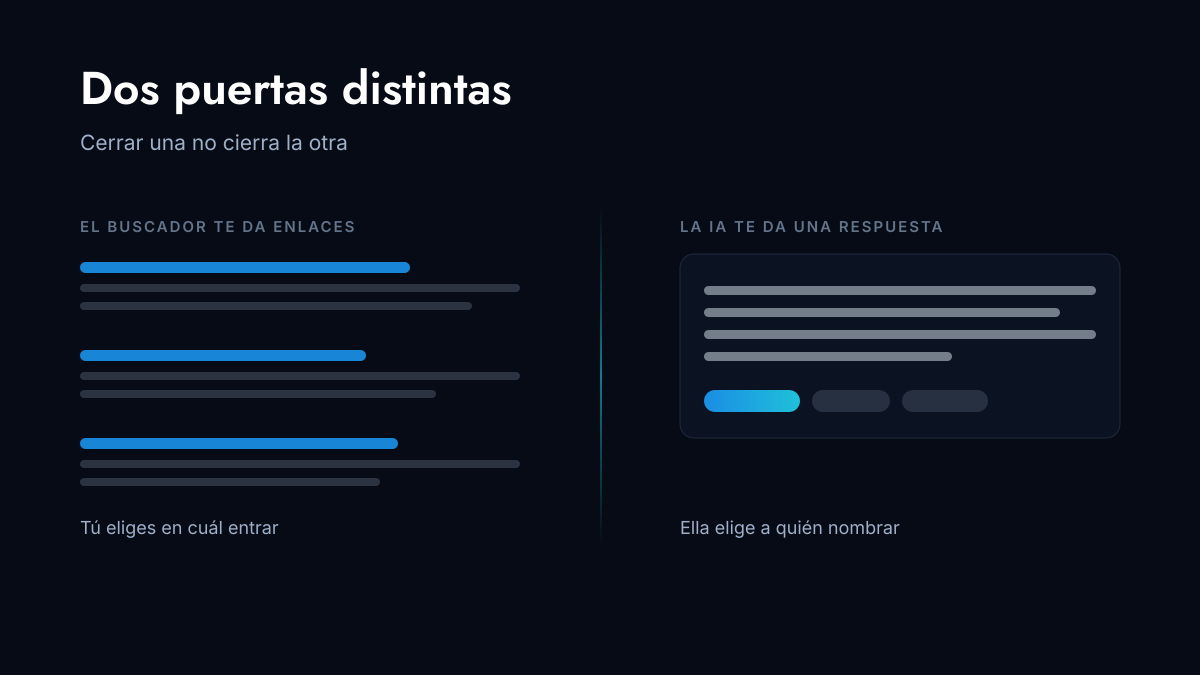
SEO is about getting Google to show you and people to enter your site. GEO is about getting ChatGPT, Gemini or Claude to cite you inside their answer. You don't choose between the two: they share almost the entire technical foundation and separate on the content. Today your customer uses both on the same day, often without realizing they're doing it.
What changed on Google's results page
Here's the point almost nobody explains in the boardroom. The discussion is usually framed as "Google versus AI", as if they were two different places. They aren't: AI is already inside Google.
For a couple of years now, a good share of searches no longer opens with a list of links but with a summary written by an artificial intelligence. Google calls it AI Overview, and it's worth knowing who writes it: Gemini writes it, Google's AI engine. It's the same model as the Gemini app, working inside the usual search engine.
And there's a layout detail that changes the business arithmetic: that summary sits above everything, even above the paid ads. The page now looks like this:
The first organic result, the one SEO works for, has ended up third in line: first AI answers, then the ads charge. It isn't that SEO stops working; it's that the same position is worth less than it was three years ago.
The consequences have been measured. Close to 8 out of 10 people rely on those summaries a good part of the time, and in searches where the summary appears most are resolved without anyone entering any website. If your Google traffic dropped without your positions moving, this is the explanation —and it isn't your agency's fault.
Why being recommended by AI weighs more than a click
It's tempting to read the above as bad news. It's worth turning it around, because what's on the other side is better than what was there before.
A result on Google is an option: you come out sixth of ten and the person decides. A mention inside an AI answer is something else — it's a recommendation. When someone asks "which logistics agency suits me in Bogotá?" and the model names three companies, those three didn't compete for attention: they arrived endorsed. The conversation with that customer doesn't start at "who are you", it starts at "how much".
And it arrives before the phone rings. Bain found that 85% of B2B buyers already have their supplier list assembled before contacting the first one. If your name isn't on the list AI put together, you didn't lose the bid: you were never invited. That's exactly what happens to companies that discover AI recommends their competition and doesn't name them.
There's also a reason of scale not to treat this as an experiment. Google's AI summaries reach more than two billion people a month, and since Gemini writes them, the engine delivering the most AI answers in the world is probably not ChatGPT but Gemini —by our estimate, around 60% of the total, though the range is wide. Put another way: most people already receiving AI answers didn't open a chatbot to do it.
What SEO and GEO share
More than is usually sold. A fast, readable, well-structured site with content that genuinely answers questions serves both. When someone offers you "GEO" as a completely new and separate service, it's worth asking what exactly they do that isn't well-executed SEO —that is, in fact, one of the questions worth asking an agency before signing.
The common foundation is concrete: site speed and structure, content that answers specific questions, clear business data —what you do, for whom, where— and mentions on other sites.
Where they genuinely separate
The difference is in the shape of the result and in how you compete.
- On Google you compete for a position in a list. There are ten results; being sixth still counts for something.
- In AI there's no list. The answer mentions two or three names. Either you're in, or you don't exist for that person. There's no visible second place and no second page.
And there's a difference in sourcing that changes the work: Google decides mostly with your site and with who links to you. AI builds its answer from what others publish about you — that's why third-party mentions weigh more in GEO than in classic SEO, and why it can't be solved by writing on your own blog alone.
| SEO · Google | GEO · AI engines | |
|---|---|---|
| What you're after | That it shows you and people enter your site | That it cites you and recommends you in the answer |
| How you compete | For a position among ten | You're in the answer or you're not |
| Where the answer comes from | Your site and who links to you | Mostly what others publish about you |
| What gets measured | Clicks, impressions and position | How many questions you appear in |
| How long the work takes | The technical part, weeks · the content, all year | The technical part, weeks · the mentions, all year |
| When results show | Three to six months to climb positions | Two to four months to appear in more answers |
| What they share | A fast, readable site · content that answers specific questions · clear business data · mentions on other sites | |
Almost the entire technical foundation serves both. That's why splitting them into two contracts is usually artificial.
Why moving the SEO budget to GEO isn't a good idea
Because the sizes aren't comparable. In Colombia, 93.7% of searches still go through Google. Emptying that channel to fund the other leaves unattended the place where your customer still starts almost every time.
The right reading isn't "switch channels" but recognizing that the same effort on Google performs worse than it did three years ago, because the organic link is no longer the first thing seen. SEO is still mandatory: it holds up the bottom half of the page and feeds with content what AI later cites. GEO doesn't replace it — it covers the piece Google stopped delivering.
So which of the two do I hire?
The question is badly framed, and it's where budget gets lost: they aren't two services, they're two ways of looking at the same work. More than half of what has to be done serves both —a readable site, content that answers specific questions, explicit business data, mentions on other sites. Splitting it into two contracts means paying twice for the same foundation and, above all, ending up with two suppliers pointing at each other the day the number doesn't move.
What you do have to choose is who. And the criterion is no longer "do they do SEO or GEO?", because today everyone says they do both. The criterion is where they start. Whoever begins by handing you a keyword list with search volumes and an analysis of who's in the top ten is working with the old yardstick: fighting for a position in a list that, as you saw above, now sits third on the page. Whoever begins by asking which customer you want to sell to, translates that into the questions people buy you for and measures how many of them you appear in —on Google and in AI engines— is measuring what actually decides the purchase today. Position is still watched; what stopped working is treating it as the objective.
That's the practical reason to hire SEO and GEO as a single service, with one person responsible and one number to measure against: the work is the same and what changes is where the result is verified. The eight questions to find out whether the person in front of you works that way are in what to ask before signing, and the investment ranges are in what ranking on Google and in AI costs in Colombia.
That's why we work them together in a single SEO and GEO service: the customer doesn't choose between Google and ChatGPT, they use both on the same day —and often the AI answering them is the one living inside Google.
Frequently asked questions
Is GEO going to replace SEO?
Not in the short term. In Colombia 93.7% of searches still go through Google. What did change is that showing up on Google no longer guarantees visits, because the AI answer comes before the ads and before the organic links.
Who writes the AI summary that appears on Google?
Gemini, Google's artificial intelligence engine. It's the same model the Gemini app uses, running inside the search engine. That's why working so Gemini understands you improves both things at once.
Does the SEO I already did count for GEO?
A good part of it does. The technical foundation and content that answers specific questions serve both. What doesn't count is content written to stuff keywords.
Can both be measured?
Yes, with different metrics. SEO with Search Console data. GEO by putting your business's real questions to each engine and counting how many you appear in.
Which gives results faster?
It depends on the starting point, and it's worth not confusing the work with the result. The fastest case is a site with AI crawlers blocked: opening that door is days of work and the result can show in weeks, because the content was already written and nobody could read it. If the problem is content or mentions, both fronts take months: two to four in GEO, three to six in SEO.
Does AI name your brand?
Enter your domain and we tell you in seconds whether AI already recognizes your brand, and what your site is missing for the engines to read you.
Free, in seconds, no signup.