How to choose an SEO and GEO agency in Colombia

Your next customer no longer starts on Google: they ask an AI and get three names. These eight questions tell you whether the agency in front of you knows how to get you into that answer.
Your next customer no longer starts on Google. They open ChatGPT, type "I need an agency to help me with this in Colombia, which one do you recommend?", and get three names. If your company is in that answer, that person arrives at your site with the decision half made. If it isn't, they never knew you existed. Appearing there —and continuing to appear on Google— is a concrete objective: it's defined, measured and reached. These eight questions tell you, in the first meeting, whether the agency in front of you knows how to get you to that result.
Why showing up on Google is no longer enough
In Colombia, 93.7% of searches still go through Google, and whoever abandons it loses. The change is in what happens after the search. Close to 6 out of 10 searches today end without the person entering any site: the summary at the top resolved their question. According to Bain, 8 out of 10 users already rely on those AI summaries a good part of the time.
That has a consequence many marketing managers have already seen in their reports: climbing positions stopped translating automatically into more visits. You can go from eighth to third and see the same traffic or worse, because the answer is being delivered before the click exists.
At the same time, close to 1 in 3 people now start by asking an artificial intelligence directly. In Colombia that conversation goes almost entirely through two doors: ChatGPT and Gemini account for around 90% of usage. And whoever arrives at your site from one of them is worth more: Semrush's study on AI traffic found that visitor is worth about 4.4 times what a regular organic visitor is worth, because they arrive with the comparison already done.
There's the objective, said plainly: it isn't about having more visits, it's about being among the options named when someone is deciding who to hire — in Google's list and in the AI's answer. The first is called SEO; the second, GEO. Today they're hired together because the customer uses them together.
SparkToro and Bain, 2026. And among the searches where there's still a click, the first result receives up to 61% less than before the summaries (BrightEdge). Climbing positions still matters, but it no longer delivers what it used to: that's why the right question to an agency isn't "what position will you get me to" but "which answers will you get me into".
The short answer: what to ask of an SEO and GEO agency before signing
Ask for five concrete things: which specific questions you want to appear in, an initial measurement with a number for where you stand today, that the accounts are in your name, a written plan for the first 90 days, and clarity about what happens if you leave. If any of them is answered with generalities, there's your answer.
The eight questions below develop those five, with the answer someone who knows should give you and the signal worth not letting pass.
SEO and GEO: in AI there's no second place
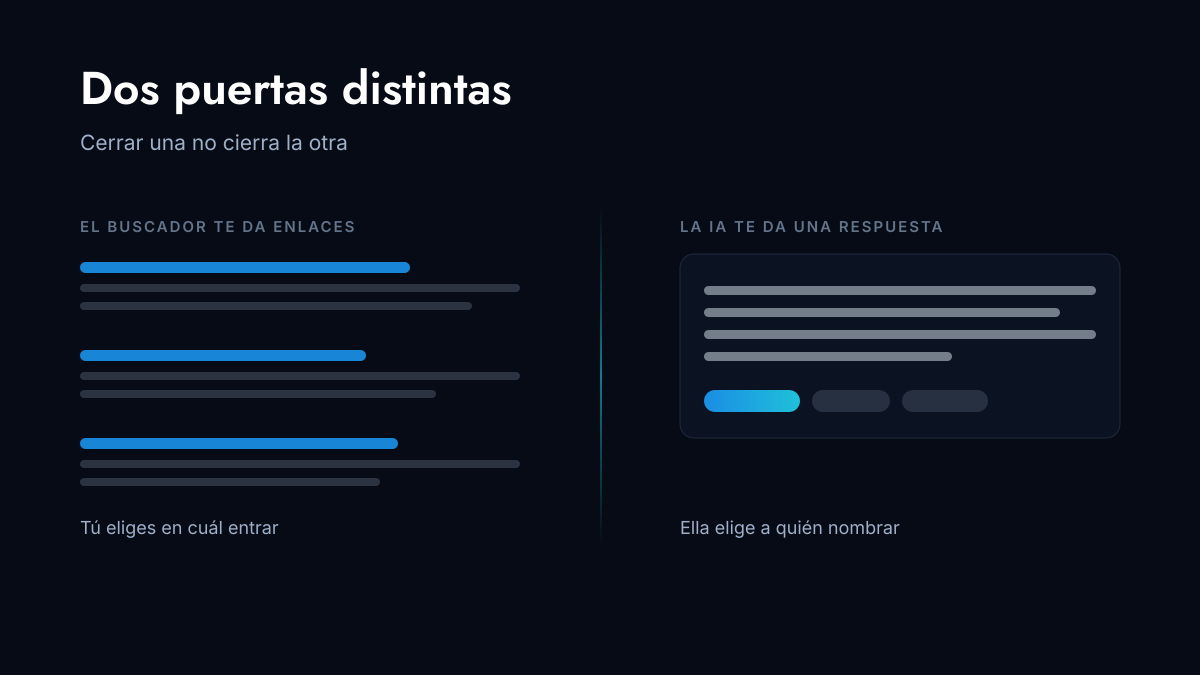
For fifteen years "ranking" meant one thing: showing up at the top of Google. Today the work splits into two fronts that support each other but aren't the same:
- SEO — that Google shows you and people enter your site.
- GEO — that artificial intelligence engines cite and recommend you when someone asks about what you sell.
The practical difference: on Google you compete for a position in a list. In AI there's no list. Either you appear in the answer or you don't exist for that person. There's no visible second place.
Many agencies still sell the first and stick the word "AI" on top. If you want the detail of what the two fronts share and where they genuinely separate, it's in SEO or GEO: which one does your company need. The questions below are for telling apart whoever knows how to do them.
1. Which specific questions will you work on so my company appears?
What they should answer: with complete questions, written the way a real customer writes them. "I need a company in Cali to help with the accounting for my small business, which one do you recommend?" is a question. "Accounting Cali" is a keyword, which is something else.
And there's a detail worth looking at before judging the answer: where that list came from. If they hand it to you ready-made in the first meeting, without having asked you anything, it came out of a search-volume tool. The good list is built with you: the agency should put the question back to you —which customer do you want to sell to, which line do you want to grow— and bring you the list in writing afterwards for you to approve. It's your business that decides which questions are worth appearing in; the agency brings the craft of translating and measuring them.
Warning sign: being handed a list of 200 keywords with search volumes and nothing else. That deliverable is generated in ten minutes with a tool and says nothing about who is going to hire you.
2. Where do I stand today, with a number?
What they should answer: an initial measurement before starting work. In SEO it's easy, because there's Search Console data. In GEO the figure has to be produced, and that's where the trap is: opening ChatGPT and asking one question isn't measuring. Engines don't answer the same way twice —it changes with how you ask and when— so a single query is an anecdote, not a starting point.
What distinguishes a measurement from a query is that it's built on what you want to sell, and that shows in five things you can ask for one by one:
- The questions come from your commercial objective, not from a generic list. They're built from what you want to be known for and which customer you want to reach, and they're weighted: the line of business you want to grow counts more than the one you're leaving behind.
- They're written the way a customer writes them —"I need a company that…"— and they cover the different moments of the decision: who do you recommend, I have this problem, comparing options, how much does it cost, who is there in my city. Appearing only when people search for you by name isn't visibility: it means they already knew you.
- There are enough of them for the result to be data, not an impression. With two or three queries chance is in charge; with volume, the pattern holds.
- The engines your customer uses are queried, with web search active. If the engine answers from memory, you're measuring what it learned months ago and not what it tells a buyer today.
- More than a yes or no is recorded: where in the answer you appear, which competitors come up when you don't, and which sources the engine drew on. That last list is the most useful of all, because it says exactly which sites you need to be on.
And it has to be repeatable: the same method and the same questions every month. If they change between one measurement and the next, no comparison is possible — there are two different photographs. When the business objective genuinely changes, the list is adjusted on purpose and noted down.
Warning sign: "we'll see how it goes", or a measurement consisting of three ChatGPT screenshots. If there's no number at the start, there'll be no way to discuss the result at the end. And that ambiguity suits whoever is charging more than it suits you.
If you already know AI names your competitors and not you, the specific causes —and the order to fix them in— are in why ChatGPT doesn't mention your company.
3. Are the accounts in my name?
What they should answer: that Search Console, Analytics and any measurement tool are created with your corporate email and the agency comes in as a guest. It's a five-minute administrative detail that decides whether the day you leave you take your history with you or start from zero.
Warning sign: accounts in the agency's name "to keep it simple". The same applies to the domain and the hosting.
4. What exactly happens in month 1, month 2 and month 3?
What they should answer: a written plan with tasks, not with concepts. The difference shows in an example:
- Task: "in month 1 we rewrite the audit service page and publish two articles: one answering how much an audit costs for a small business and another on how often it has to be done".
- Concept: "on-page optimization and content strategy".
The first can be reviewed at month end with a yes or a no. The second can't be breached, because it doesn't say what it is. Notice too that each task says on which page or which question it's done: that's what later allows the work to be connected to the number from point 2.
Warning sign: proposals listing activities without saying how many, on what, or who does them.
5. What do you need from me, and when?
What they should answer: a short, honest list —access, someone to review copy, half an hour a month to answer questions about the business. But the first item on that list isn't access: it's where your company is heading.
And it isn't a filler question to break the ice. It's the input everything else comes from:
- What you want to be known for, which is almost never the same as what you bill today. It's what you want to be bought for in two years.
- Which line you want to grow and which you're leaving behind. Ranking well for a service you plan to drop is spending the budget building the wrong reputation.
- Which customer you want, not the one you get today. If you want to move up in ticket size, the questions you need to appear in are different ones.
- Which new markets are coming — another city, another country, another sector.
That's where the questions measured in point 2 come from. If that conversation doesn't happen, they'll rank you where you already were: the agency looks at your site, sees what you used to sell, and works for that. The typical result is a blog that keeps teaching what the company did five years ago, which is also exactly what AI learns and repeats about you.
And that conversation repeats, it isn't held once. Businesses move: a line opens, another closes, the segment goes up. Every three months it's worth returning to the same question —is this still where we're heading?— and adjusting the list of questions when the answer changes. With one technical caveat: if the list changes, the comparison with previous months breaks, so the change is made on purpose and noted down, not on the fly.
Warning sign: "we don't need anything from you". It sounds convenient and it's the recipe for generic content that doesn't distinguish your company from the other forty in the sector. The other, quieter signal: an agency that asked where you were heading in the first meeting and never asked again.
6. What can you promise me and what can't you?
What they should answer: a clear no on positions —nobody controls Google's algorithm or ChatGPT's— and, in exchange, a long list of concrete commitments. That the position can't be guaranteed doesn't mean everything is uncertain: almost everything that decides the result does depend on the work, and that's why it can be committed to.
What should be committed to, in writing:
- That your site is left readable for AI engines. This isn't a probability, it's a switch: either the crawlers get in or they don't. It's guaranteed and verified.
- How much work gets done and on what. How many pages get written or rewritten per month, which ones, and who does it. It's an execution commitment and it's either met or it isn't.
- That it's measured every month with the same yardstick, and that you see the number, whether it comes out good or bad. If it didn't move one month, that gets said.
- Progress on indicators that do depend on the work: how many of your buying questions already have a page answering them, how many new mentions were earned, how many pages were left with up-to-date data. None of that depends on the algorithm.
- Timelines, separating the work from the result. When each task is done —the technical part in weeks, the first pages in the first month— and when the effect should start showing —appearing in more questions, between month 2 and month 4. They're two different calendars and a good supplier gives you both separately, even if they can't promise the final result.
- That the content, the pages and the access are yours and stay with you no matter what.
- A review point with a consequence. At 90 days the number gets looked at: if it didn't move, what changes and who takes on that rethink. Committing to review is easy; committing to what happens next is what sets someone apart.
Seen that way, the list of what is promised is much longer than the list of what isn't. The only thing left out is the exact position, which is precisely what nobody controls.
Warning sign: "first page guaranteed" or "appear in ChatGPT in 30 days". Google has spent more than a decade asking people to distrust anyone guaranteeing positions, and in AI engines the promise is even harder to sustain: the answers change depending on how each person asks. The other side is a signal too: whoever only tells you what they can't promise, and offers no concrete commitment in exchange, is covering their back.
7. How do you get other sites to mention us?
What they should answer: earned mentions —press, real sector directories, partnerships, content someone finds worth citing. In GEO this weighs more than in SEO: AI engines build the answer from what others say about you, not from what you say about yourself.
In companies selling to other companies this weighs even more, because the supplier shortlist is assembled before the first call: the detail is in AI visibility for B2B services.
Warning sign: packages of "100 backlinks" for a fixed price. That's link buying, it has gone against Google's policies for years, and the risk is carried by your domain, not the agency's.
8. What happens if I leave?
What they should answer: that the content, the pages and the access are yours and stay. It's normal for there to be a minimum term —the work doesn't pay off in a month— but it should be written down and finite.
Warning sign: content being removed when the contract ends, or the site living on a platform owned by the agency that you can't take it out of.
What an SEO and GEO agency costs in Colombia
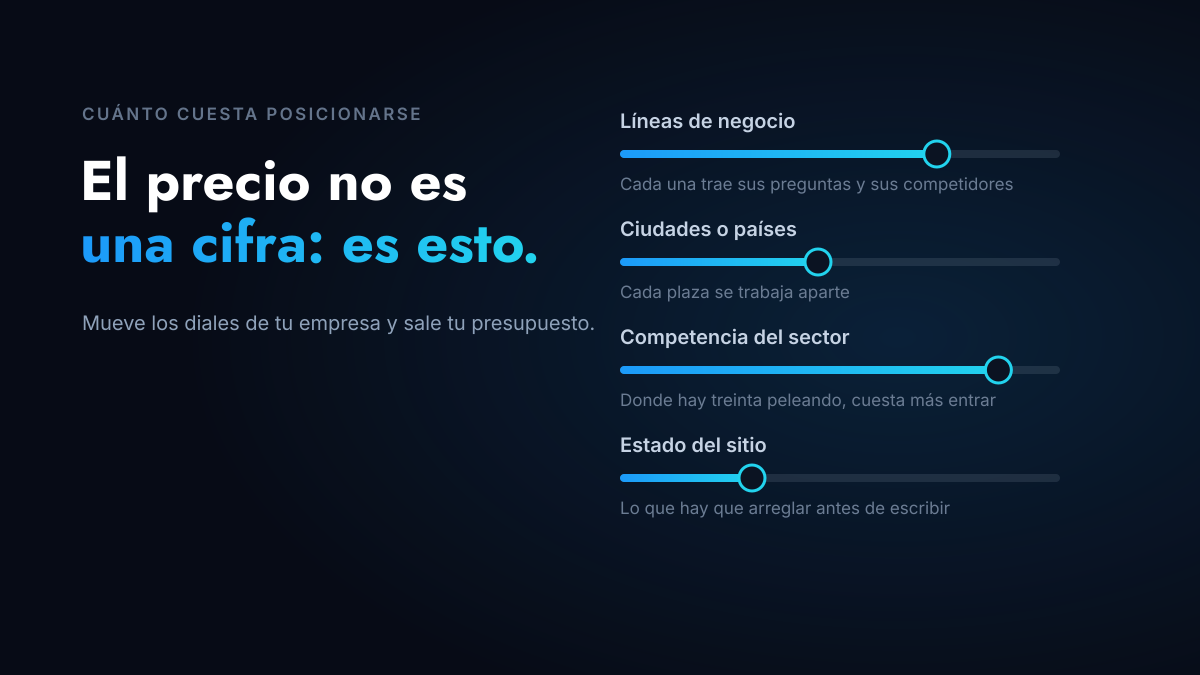
In Colombia the range is wide and it's worth understanding what explains the difference. A serious monthly SEO and GEO service for a services company starts at around COP 3,000,000 a month and goes up depending on how many lines of business have to be worked. Below a million, what's usually being sold is an automated report and two posts a month.
Before signing a monthly retainer, the sensible thing is to pay for a standalone measurement: it costs little, commits you to nothing and leaves you with a diagnosis that's useful even if you hire someone else. In our case that diagnostic costs COP 490,000, measures your visibility in ChatGPT, Gemini and Claude, compares it with your competitors' and ends in a 90-day plan.
The breakdown by tier, with what each includes, is in what ranking on Google and in AI costs in Colombia.
How we work at Statum Digital: the objective first, in numbers
At Statum Digital, our SEO and GEO service always starts by defining the objective in numbers, and the order isn't accidental: first we agree with you which questions you want to appear in, then we put those same questions to the three AI engines and count how many you appear in today. That number is the baseline you start from, and every month's progress is measured against it.
We're an agency from Cali. We work with professional services, B2B and healthcare companies, among other sectors; what they have in common isn't the industry but that the sale is decided on trust and with a ticket that justifies the work. That defines both what we do well and what we don't: we take on few accounts at a time, and we aren't the option for anyone looking for the cheapest supplier on the market.
And if you want the figure before talking to anyone, right below you can check for free whether AI recommends you: it takes seconds and asks for no email.
Frequently asked questions
How long until a result shows?
Worth separating two clocks, because they don't run at the same speed. The work clock —what the agency does—: the technical review is ready in weeks, the first rewritten pages within the first month, and mentions are earned bit by bit throughout the year. The result clock —what you see—: the first thing that moves is how many buying questions you appear in, between the second and fourth month; visits and leads come after that; and the sale also depends on your sales process, not only on visibility. When someone gives you a single timeline for everything, they're bundling things that don't happen at the same time.
Can first place on Google or in ChatGPT be guaranteed?
No. Nobody controls those algorithms. What can be committed to is the work —what gets done, how often and how it's measured— and that commitment should be in writing.
Is it worth hiring SEO without GEO, or the other way round?
They share more than half the work, so separating them is usually artificial. The sensible thing is to start with the common foundation and decide the priority with the measurement, not with the fashion.
What happens to my content if I end the contract?
It should stay with you: the pages, the copy and the access are yours. If an agency puts conditions on that, it's reason enough not to sign.
I already have an SEO agency. How do I know if it's working?
Ask them for two things from the last quarter: which buying questions you appear in today and which you appeared in before, and which pages were written or rewritten, with their links. If the answer comes back as positions and visits but nobody knows whether AI names you, it isn't that they're working badly: it's that they're measuring half the board. Before changing supplier it's worth having your own number; with that the conversation stops being about opinions.
How much time do I have to put into this?
The initial meeting of one to two hours —the one about where the business is heading— and after that around half an hour a month to review copy and answer sector questions. Less than that usually means the content is being written by someone who doesn't understand what you sell, and it shows.
Do I need to rebuild my website before starting?
Not necessarily. What does have to be checked up front is that AI crawlers can read it and that the service pages say clearly what you do, for whom and from where. That's fixed on the site you already have. Rebuilding is justified when the platform doesn't let you touch the copy or the site can't be read without running code in the browser — not as an entry requirement.
Does it work if I only sell in my city?
Yes, and it usually pays off faster, because competition for "in Cali", "in Medellín" or "in Barranquilla" is far lower than national competition. In AI engines the question with a city is one of the most frequent when someone is about to hire a service.
Should I hire an agency or a freelancer?
It depends on the scope of the work, not the size of the supplier. This mixes three different crafts —the technical side of the site, the writing and the monthly measurement— and a very good freelancer covers all three while the volume is small; beyond a certain point they need support. So the decision isn't made on the setup but on the answers: ask both the same eight questions. Whoever can't tell you with a number where you stand today won't be able to show you later what progressed, working alone or in a team.
Do I have to sign a minimum term?
It's reasonable for there to be a minimum, because the work doesn't pay off in a month and the agency takes on the big effort at the start. What isn't reasonable is for it to be open-ended, unwritten, or for leaving to mean losing the content. A minimum of three to six months, with a clear exit, is the norm.
Does AI name your brand?
Enter your domain and we tell you in seconds whether AI already recognizes your brand, and what your site is missing for the engines to read you.
Free, in seconds, no signup.