How to choose who runs your paid media

Reports full of reach and impressions while the question that matters goes unanswered: what each customer cost. Ten signs that show up without logging into any platform, and what the monthly report should bring.
No company hires advertising to receive a report: it hires it so customers come in. That is precisely the conversation many reports dodge. They arrive loaded with reach, impressions and engagement —figures that go up just by raising the budget— while the question that matters in the boardroom goes unanswered: how much it cost to get each customer. Spotting it doesn't require knowing ad platforms, it requires knowing and understanding the KPIs: which ones to review and at what point they let you scale, are healthy, or are badly off.
Before looking outward, it's worth looking inward: sometimes the problem isn't the advertising, it's the offer. If the product doesn't have proven demand yet, if the price is above what the market is paying today, or if the leads that arrive sit two days waiting for a reply, no campaign is going to make up for it. Advertising is an amplifier, and that's its best side: when the offer is sharp, the result shows quickly. Telling them apart is simple. If leads of the right profile are arriving and still don't close, the ground to win is in the offer and the sales process, which is where the needle moves fastest. And if you're already solid there, this is what you can demand from whoever runs your spend.
The short answer: what to demand from whoever runs your advertising
Three things, in writing: that the ad accounts are in your name, that conversion tracking is installed and verified, and a report that doesn't just show how much was spent but the KPIs, how they performed against target and the month-to-month comparison. If any of these is missing, you may be paying for your budget to be burned.
The problem isn't the platform, it's what you measure against
Digital advertising has a convenience that plays in the supplier's favor: the metrics that always look good don't require getting anything right. Reach, impressions and engagement go up just by raising the budget. They're true and they're useless for deciding.
The useful ones are uncomfortable because they can come out badly, and that's exactly why they let you decide. If you sell services, the dashboard is: what each person who left their details cost, how many of those were real customers and what each closed sale cost. If you sell online, it's: what each purchase cost, how much each peso invested returns —the ROAS—, what the average order value is and at what point between the click and the payment people are dropping off. If that doesn't appear in the report, it's almost always because nobody is looking at it. Asking for it changes the next meeting's conversation: you stop discussing how much was spent and start deciding on results.
The three numbers on the left are real and can't be argued with. The point is another: none of them changes a decision. With the ones on the right you decide which campaign gets switched off on Monday, whether you sell services or sell online.
Ten signs your advertising is being badly run
None of them requires you to log into the platform. All of them show up in the report or from a direct question.
- There was no research before starting. Before the first ad there's work someone has to do: understand the business model and the margin each product leaves, review the market and who is buying, study what the competition offers and at what price, and define which offer you go out to compete with. That gets delivered, not narrated: if that analysis doesn't exist, the campaign was set up blind and what you have is ads switched on to see what happens. It's the part that produces the strategy, and it doesn't take months: it's a few days that give direction to the rest of the year.
- There's no plan and nothing is being tested. Good management shows in there being a written hypothesis —who we're talking to, with what message, with what offer— and a testing calendar to confirm or discard it. If every month is exactly the same and nobody knows what's being tested, the account isn't learning, and an account that doesn't learn gets more expensive over time.
- The report doesn't say what each lead cost. It's the most basic number in the trade: spend divided by valid leads. If it isn't there, either it isn't being measured or it isn't convenient to show.
- The accounts are in the agency's name. The Meta business manager, the Google Ads account and the pixel should be yours, with the agency invited. If they aren't, the day you change supplier you lose the learning history, which is exactly what makes advertising perform better over time.
- There's no conversion tracking, or anything counts as a conversion. It's one of the first things to get in place, before spending the first peso. Installing it properly is documented by Google itself and it's an afternoon's work. Counting "clicks on the WhatsApp button" as if they were customers inflates the report and misleads the platform itself, which then optimizes to get more useless clicks.
- Nobody asks what happened with the leads. If the salesperson doesn't report back which ones were serious, the campaign keeps optimizing toward the wrong type of person for months. That feedback loop is what separates advertising that learns from advertising that only spends.
- The same campaign has been running for months, with the same ads. Creative fatigue is real: the same piece shown to the same audience costs more every time. With no new pieces coming in, the cost per result rises on its own.
- The ads lead to your site's home page or an Instagram profile. The ad promised something specific and the landing page talks about the company in general. That's where a good part of what you paid to bring that person gets lost.
- They show you the total spend, not the breakdown. How much each campaign and each ad took, and why. Without that there's no way to know whether the budget is concentrated where it works or split in equal parts for convenience.
- They promise you a fixed number of leads per month. Nobody controls the auction or the competition. Work, testing frequency and transparency can be committed to; the exact result can't.
What the monthly report should include
The metrics that actually move your business. As a CEO it's worth being clear on which KPIs you should be watching, because they change depending on what you sell. The report should always bring those KPIs and their month-to-month evolution, in the same format, so you can compare without having to interpret.
If you sell high-ticket services, with few deals a month and a long sales cycle, the numbers that rule are cost per valid lead, how many of those your sales team qualified, how many reached proposal stage and what each signed client ended up costing. The volume is low, so the reading is done by quarter and not by week. In this scenario Google and LinkedIn usually weigh more, because they pick up whoever is already looking for a solution.
If you sell consumer products online, the dashboard is different: cost per purchase, return per peso invested, average order value, site conversion rate and how much the same customer buys again. The volume is high and the decision is fast, so it's read almost daily. Here Meta and TikTok usually weigh more, because the product is discovered in the feed before anyone searches for it.
On that basis, the report should always bring the same things: total spend and spend per campaign · results and their unit cost · performance against the month's target · comparison with previous months · what was tested and how it turned out · what gets switched off, what gets raised and why. Half a page done well is worth more than twenty slides.
One detail that avoids unnecessary arguments: each platform distributes the budget its own way. Google can spend above your cap one day and make up for it another, and Meta redistributes between ad sets depending on where it's finding results. That's why a single day's spend almost never matches the daily budget: that's looked at by period, not by day.
And a warning that saves arguments: the platform and your internal system will never give the same number. Meta attributes differently to Google, and both attribute differently to your CRM. What matters isn't that they match, it's choosing a single source to make decisions with and not changing it every month to suit.
Before signing: five questions
- Are the accounts in my name? Meta, Google, the pixel and the conversions. The right answer is yes, with no qualifiers.
- How are you going to measure a lead? Have them define what counts as a valid lead before starting, not after.
- How many new pieces get tested per month and who makes them? If creatives are separate —as is usual— have it stated what they cost.
- Where does the traffic land? If a campaign page is needed, who builds it and at what cost.
- What happens if I leave? Accounts, pixels, history and creatives stay with you.
There is one part of the work, though, that isn't the job of whoever runs the advertising, and it's worth being clear on before sitting down to negotiate. When you sell online, the loop closes itself: the platform records the purchase and the data comes back complete. When you sell through leads, it doesn't. To know which of those leads ended up as customers you need a properly configured CRM and, above all, a sales team that feeds it every day. That belongs to your company, not to the advertising supplier, and it isn't reasonable to expect it to be set up for free inside the fee. What is reasonable is to ask about it: many agencies —us included— offer it as a separate service, and it's usually the highest-returning investment of all, because without that data the campaign will never know what type of person to look for.
They're the same five worth asking anyone, and they resemble the ones used to hire ranking work: the detail is in what to ask before signing with an agency.
How we do it at Statum Digital
As with everything we do, strategy comes first, and for that the first step is research. Before switching on an ad we review what your competition is advertising —each platform's ad library shows it openly—, which pages that traffic is being sent to, what type of content is working for them and what people are searching for in your category. With that we know which messages we'll be competing against, which format makes sense to test first and where there's room to stand out.
With that ready, we run advertising in a single multi-platform package —Meta, Google, TikTok and whatever applies—, with the accounts always in the client's name, a live dashboard so spend and results are visible without waiting for the report, and a monthly review where we decide what gets switched off and what gets raised.
You pay the ad spend yourself, directly to the platform, and we do it that way on purpose because it plays in your favor: the money doesn't pass through a middleman, you see the real spend in your own account the same day, the invoicing is in your name and the learning history stays with you no matter what. We charge for managing, not for moving your budget.
On creatives we start from your best content: what's already working for you on social usually performs better in advertising than a piece made from scratch, and using it saves you time and money. If you don't have it yet, or you want to raise the level, we produce with our partners and put together a content package for your case. It's separate from the management fee —like the campaign page— because it's production, and that way each thing is priced for what it's worth. The ranges for both are in what paid media management costs in Colombia.
Frequently asked questions
How do I know if the problem is the advertising or my product?
You separate it by looking at two things: if leads arrive but your team says they aren't the right profile, the problem is in the targeting and in what's being optimized for. If leads of the right profile arrive and don't close, the problem is no longer advertising but the offer, the price or the sales process. Confusing the two cases is the most common reason agencies get changed without anything improving.
How long should a campaign run before judging it?
Worth separating the work from the result. The setup and the measurement are ready in days. To judge performance the campaign needs to accumulate enough results for chance not to be in charge: on small budgets that can take several weeks. Switching a campaign off after three days is as expensive as letting it run unwatched for three months.
Is it normal for the agency to charge a percentage of the spend?
Yes, it's a common model and there's nothing wrong with it as long as it's written down and understood: the more spend managed, the more management work. What's worth checking is that there's also a fixed part, that the spend ceiling is set by you in writing and that the report shows the cost per result month to month. With those three, any budget increase stops being a recommendation from your supplier and becomes a decision of yours made with numbers.
My budget is small. Is it worth hiring someone?
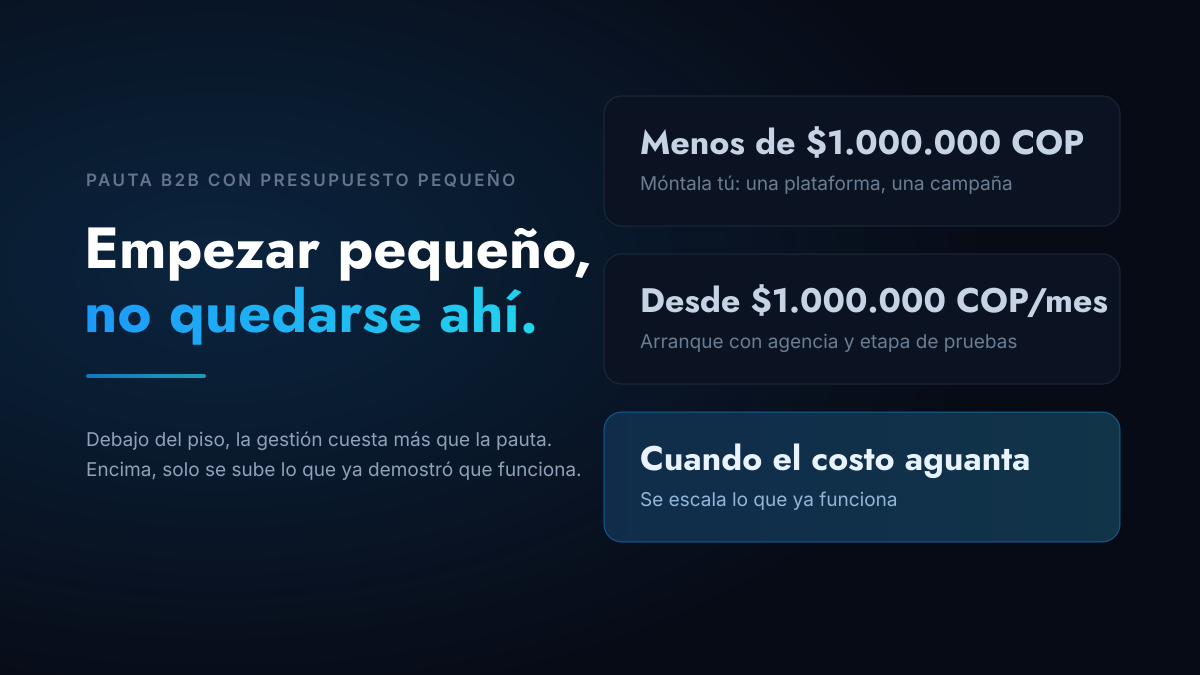
It depends on the ratio between the fee and the spend. If what you pay the supplier weighs more than what goes to the platforms, it's almost always better to start with a single platform and one objective, or wait until you have more capacity to invest. What doesn't work is splitting a small budget across three platforms: none of them accumulates enough data to optimize.
Can I work with my internal team and have the agency only advise?
Yes, and in companies with someone dedicated to marketing it usually works well. What has to be clear from the start is who executes what, because the typical problem isn't capacity but two sides each waiting for the other to push the changes live.
Is boosting posts from your phone any use?
For making something specific known, it can help. For getting customers, no: that button uses a reduced version of the tools, almost always optimizes for engagement and doesn't let you install tracking properly. It's the most frequent reason behind "I invested and all I got was people asking for prices".
What happens to the ads and the data if I change supplier?
If the accounts are in your name, nothing happens: access is revoked and you continue with your history, your pixels and your pieces. If they're in the agency's name, you start from zero, and that costs real money because platforms perform better with accounts that have already accumulated learning.
Do I need a campaign page or is my site enough?
Your site is enough when the page the ad lands on answers exactly what the ad promised. In practice that rarely happens, and that's why a campaign page usually pays for itself. It isn't a rule: it's decided by looking at how well the page you already have responds.
Does AI name your brand?
Enter your domain and we tell you in seconds whether AI already recognizes your brand, and what your site is missing for the engines to read you.
Free, in seconds, no signup.