What paid media management costs in Colombia
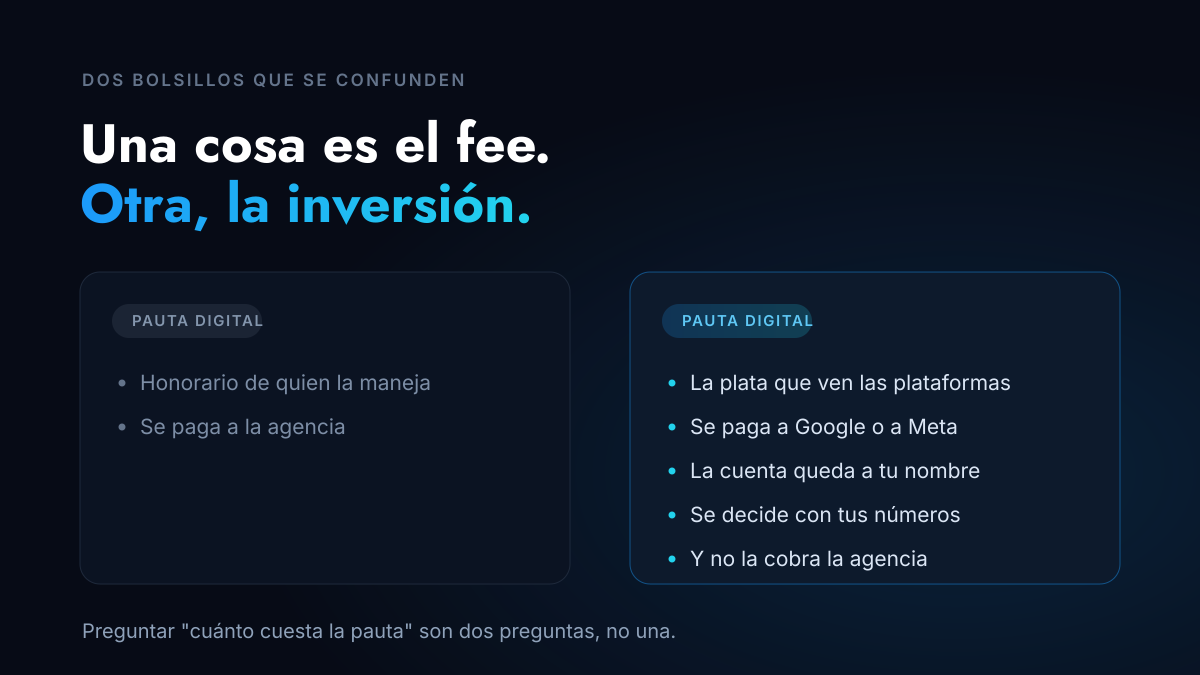
"What does advertising cost?" can mean two very different things: the fee of whoever runs it, or the money handed to Google and Meta. Separating them is the first step before looking at any proposal.
The first confusion in this conversation costs money: when someone asks "what does advertising cost?", they may be asking two very different things. One is the fee of whoever runs it. The other is the money handed over to Google or Meta. They're decided on different criteria and it's worth separating them before looking at any proposal.
The short answer: what running paid media costs in Colombia
The management fee for a services company moves between COP 800,000 and COP 3,000,000 a month —a range observed in proposals competing with ours— depending on how many platforms are run and how much spend sits behind them; with large budgets it can be considerably more. The ad spend goes separately, is paid directly to the platform and is yours. And creatives and the campaign page usually go separately too, because they're production, not management.
The three pricing models you'll come across
| Model | How it works | What to watch |
|---|---|---|
| Flat fee | The same monthly figure, whatever the spend | Clear and predictable. If the spend grows a lot, the supplier ends up working more for the same |
| Percentage of spend | A percentage of what's advertised, normally between 10% and 20% | It tracks the size of the account. Worth agreeing from the start how often it's reviewed and what happens if the spend changes a lot |
| Fixed + percentage | A monthly base plus a percentage of what's managed | The most common today. It covers the minimum work even when spend is low, and it tracks growth |
None is better on its own: what matters is that it's written down and that you know which one you're signing. What is worth making clear in all three is what happens when the spend goes up or down: how the fee adjusts, when it's reviewed and what additional work that adjustment covers.
Why a percentage of the spend is charged
It's the part of the proposal that causes the most discomfort, and it's worth explaining properly because it isn't a local invention or a way of inflating the bill: it's the model the advertising industry was born with. Agencies always charged a commission on the media they managed —the classic media commission— and that scheme carried over unchanged into the digital world. Today it's used by large and small agencies, inside and outside Colombia, and it's what you'll find in most serious proposals that reach you.
The reason is simple: the work grows with the spend. Running one million a month and running fifty isn't the same task at a different size; they're different campaigns, more segments to sustain, more pieces rotating, more frequent review and, above all, more responsibility over someone's money. A flat fee designed for the small account falls short on the large one, and one designed for the large one scares off whoever is starting out. The percentage is what allows both companies to work with the same supplier.
It also has an effect that plays in your favor: the agency only earns more if your account grows, and an account grows when it's working. Nobody scales spend that's losing money, because that shows up in the next month's report and is paid for with the whole relationship.
Now, the uncomfortable question said plainly: isn't it an incentive to recommend I overspend? It's a reasonable doubt and it's defused with three things you can demand in any proposal, ours included:
- That there's a fixed part, so the minimum work is covered without depending on how much you spend.
- That the spend ceiling is set by you, in writing. Nobody raises your budget without your authorization.
- That the report shows the cost per result month to month. That's where you see whether raising it helped. If the cost per customer holds or drops when the spend goes up, the increase was a good idea; if it shoots up, you have to go back.
With those three, raising the budget stops being a recommendation from your supplier and becomes a decision of yours, made with numbers. That's why our rate is fixed plus percentage: the fixed part sustains the work from the first month and the percentage tracks growth once the business has shown it can take it.
What the management fee should include
- Strategic judgment, not just platform handling. Whoever runs your account has to understand what makes you sell: which angles move your customer, which one gets tested first and which gets discarded. That's where the content proposals come from —which piece is needed, what it should talk about and for which moment— along with the improvements to the landing page. A good media buyer doesn't wait to be sent material: they say what material is needed and why. It isn't a deliverable with a name of its own, but it's what separates an account that grows from one that's merely left switched on.
- Campaign setup and structure on each platform that's going to be used.
- Installing and verifying the tracking. Google publishes the procedure, so it isn't a mysterious deliverable: you can ask for proof that it's working. Pixels, conversions and the definition of what counts as a result —valid lead or purchase. Without this, everything else is decided blind.
- Continuous optimization: what gets switched off, what gets raised, which audiences get tested. It isn't monthly work, it's weekly.
- A report you can decide with —spend, results, cost per lead or per purchase, what was tested and what comes next— and access to the numbers without having to ask for them.
- A regular review with your team. In services, with the salesperson, to know which leads were real. In online sales, with whoever runs the store: which product sustains the return and what happens after the purchase. That feedback loop is what makes the campaign improve month to month.
What it normally does NOT include, and is worth asking about
Three things quoted separately across almost the whole market, and which, if they appear "included", are usually a sign they'll be handled in a hurry:
- The creatives. Photos, videos and pieces. They're production and they have their own cost, which depends on how many pieces a month and whether there's a shoot or it's assembled from existing material.
- The campaign page. When the ad needs to land on something other than your current site, someone has to build it. And if the site also loads slowly or doesn't convert, that can no longer be fixed from the campaign: it's development work and it's budgeted as such.
- The tools that receive the lead. Implementing a CRM and leaving it configured, setting up an artificial intelligence agent to handle the first conversation or a WhatsApp bot that replies instantly is implementation, not advertising management. It's quoted separately and it's worth asking about before signing, because it's exactly what decides whether the leads you already bought end up as sales.
How much ad spend you need
This is the figure nobody can give you without knowing your business, but it can be reasoned in three steps with your own numbers:
- What a new customer leaves you. Not the sale: the profit, and if your service renews, the profit over the whole time they stay with you.
- How many leads you need to close one. Your sales team knows: if one in ten quotes closes, it's ten.
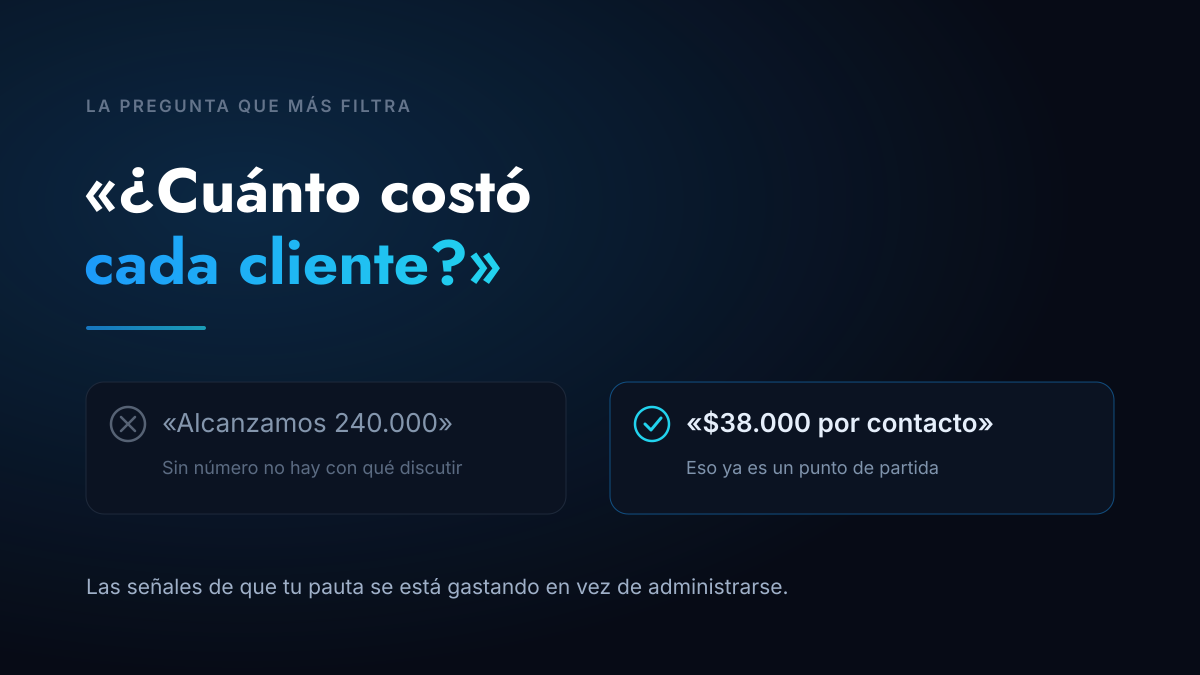
- Multiply and divide. If you can pay up to COP 500,000 per new customer and you need ten leads to close one, your ceiling per lead is COP 50,000. With that you can already judge whether a cost per lead is good or bad — which is exactly the question nobody can answer when the first report arrives.
If you sell online the calculation is the same with different names: what each sale leaves you after costs and what cost per purchase that margin can take. The ceiling is worked out the same way and read more often, because the volume allows it.
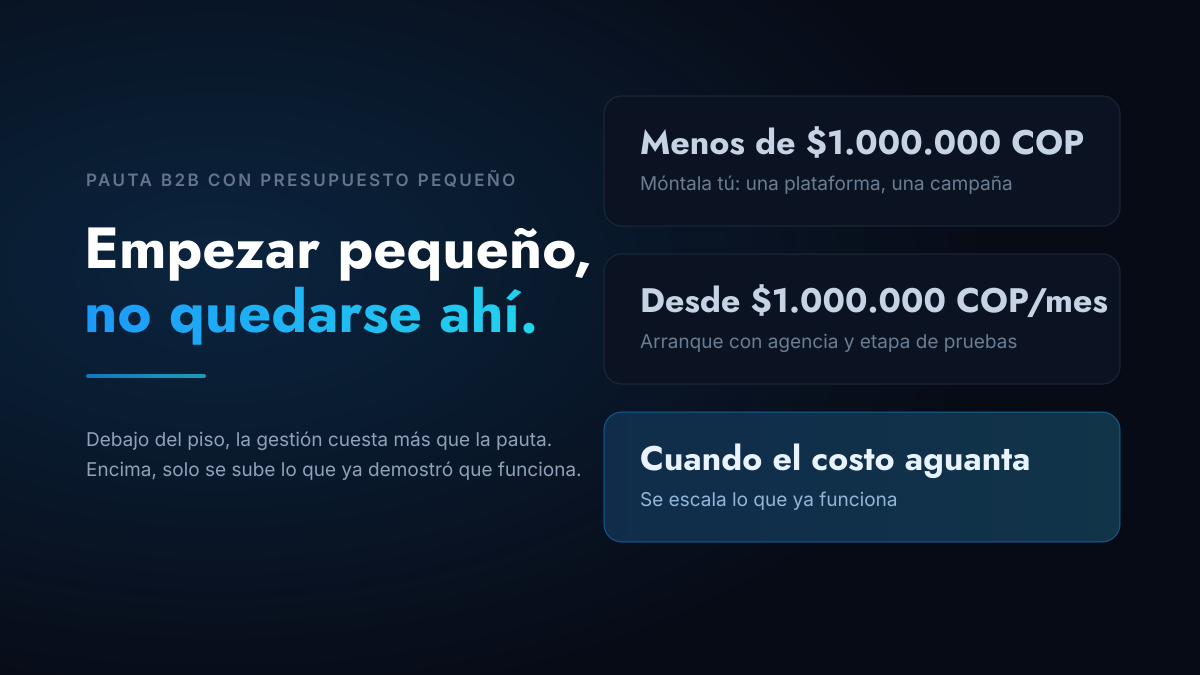
It's also worth understanding how Google distributes and controls an account's spend: daily spend fluctuates on purpose and only balances over the month, which surprises anyone who checks the account on a Tuesday. And a practical floor: below a certain spend, platforms don't accumulate enough data to optimize and the campaign stays in learning forever. Rather than splitting a little across three channels, it's better to concentrate it on one — which one depends on how people buy from you, and it's in where to advertise depending on what you sell.
What moves the price of the management
- How many platforms. Each one is a separate operation: its own structure, its own tracking and its own pieces.
- How much spend sits behind it. An account of twenty million a month demands a different level of monitoring than one of two.
- How many lines of business or cities. Positioning one service in one city isn't the same as four services in five markets: campaigns, audiences and messages all multiply.
- How contested your sector is. Where thirty companies are bidding on the same search, the click goes up and fine-grained work weighs more.
- Whether new pieces have to be produced regularly or the client supplies them.
Our rates
They're published, like those of the rest of our services. Managed multi-platform advertising costs COP 1,200,000 a month plus 10% of the managed spend, with whatever platforms are needed —Meta, Google, TikTok or whichever applies— with no charge per extra channel. It includes setup, tracking, continuous optimization, a live dashboard and reporting.
What it doesn't include, said before you ask: the ad spend, which is paid directly to the platform and stays in your name, and the creatives and the campaign page, which are quoted case by case. The accounts are yours from day one. The detail of what comes each month is on our managed paid media service.
How to compare two proposals without getting it wrong
Put both in the same table and fill in these boxes: monthly fee · whether they charge a percentage and how much · platforms included · whether tracking is included · whether creatives are included and how many · whose name the accounts go in · what the report brings · experience: which accounts they've worked on, in which sectors and with what budgets · minimum term. The cheapest proposal is almost never the cheapest: it's the one that left three of those boxes empty.
There's one question that organizes all the others, and it works for hiring any marketing service: what is committed to in writing and what isn't. If you want the detail of what to demand —and the signals that give away whoever won't deliver it— read the signs your advertising is being badly run.
And if you'd rather save yourself the round of proposals, start with ours: tell us what you sell, to whom and how much you're thinking of starting with. We'll come back with every one of those boxes filled in —fee, percentage, platforms included, tracking, whose name the accounts go in and what the report brings— and with the calculation done using your own numbers: what a customer is worth to you and how much spend it takes for the operation to work. If the case doesn't yet justify hiring anyone, we'll tell you that too; it's cheaper to hear it now than in the fourth month.
Frequently asked questions
What's the minimum spend it makes sense to start with?
More than an absolute amount, what matters is the proportion: if the management fee weighs more than what goes to the platforms, the numbers don't work for either side. As a practical reference, when the monthly spend is smaller than the fee, it's better either to raise the spend or to start on a different front.
Does VAT get added to those figures?
Yes, the management fee is invoiced plus VAT. The ad spend is charged directly by the platform and has its own tax treatment, which is worth reviewing with your accountant because it changes depending on how it's paid.
Can I pay on results only, like a commission per sale?
It's a reasonable question and the honest answer is that almost nobody serious does it, for one reason: the close depends on your sales team, your price and your product, which are things the advertising supplier doesn't control. Where something variable can be agreed is on indicators that do depend on the work, like the cost per qualified lead.
Is there a minimum term?
The norm is a minimum of three to six months, and the reason is technical before it's commercial: the first month goes on setup and on the campaigns accumulating data, so cutting it short means paying for the start without getting to collect the performance. What isn't reasonable is for it to be open-ended or for leaving to mean losing the accounts.
What if one month I want to lower the spend?
You can, and in seasonal businesses it's the logical thing. The only thing worth avoiding is switching off completely and turning back on: campaigns lose their accumulated learning and the cost per result rises again for the first few weeks. Slowing down comes out cheaper than a hard stop.
Why do some agencies charge COP 500,000 and others COP 3,000,000?
Because different things are sold under the same name: setting up a campaign and letting it run doesn't cost the same as installing tracking, sustaining weekly tests and sitting down with the sales team to review which leads were useful. Ask for the detail of tasks and frequency, and the difference explains itself.
Do I need to hire creatives every month too?
Not every month, but regularly. Pieces wear out: the same image shown to the same audience costs more every time. How much production is needed depends on the size of the audience and the spend; on small accounts renewing every two or three months can be enough.
What if I already have someone running my advertising?
Before changing, ask for two figures from the last quarter: the cost per valid lead month to month and what was tested. With that you know whether there's management or just execution, and it avoids the expensive mistake of changing supplier when the problem was in the sales process and not in the advertising.
Does AI name your brand?
Enter your domain and we tell you in seconds whether AI already recognizes your brand, and what your site is missing for the engines to read you.
Free, in seconds, no signup.