B2B paid media on a small budget: from what point it's worth hiring someone
A services company selling to other companies, a budget that isn't large and the need to start soon. From what point a management fee makes sense, what to do below that, and what has to be in place before the first lead arrives.
The question almost always arrives in the same shape: we're a services company selling to other companies, we want to start getting clients through Google and Meta, the budget isn't large and we need this to start soon. Who do we hire? Before giving names there's something worth answering head-on, because it decides everything else: at what level of spend does hiring someone make sense, and at what point does the fee eat the benefit.
The short answer: from what point hiring someone makes sense
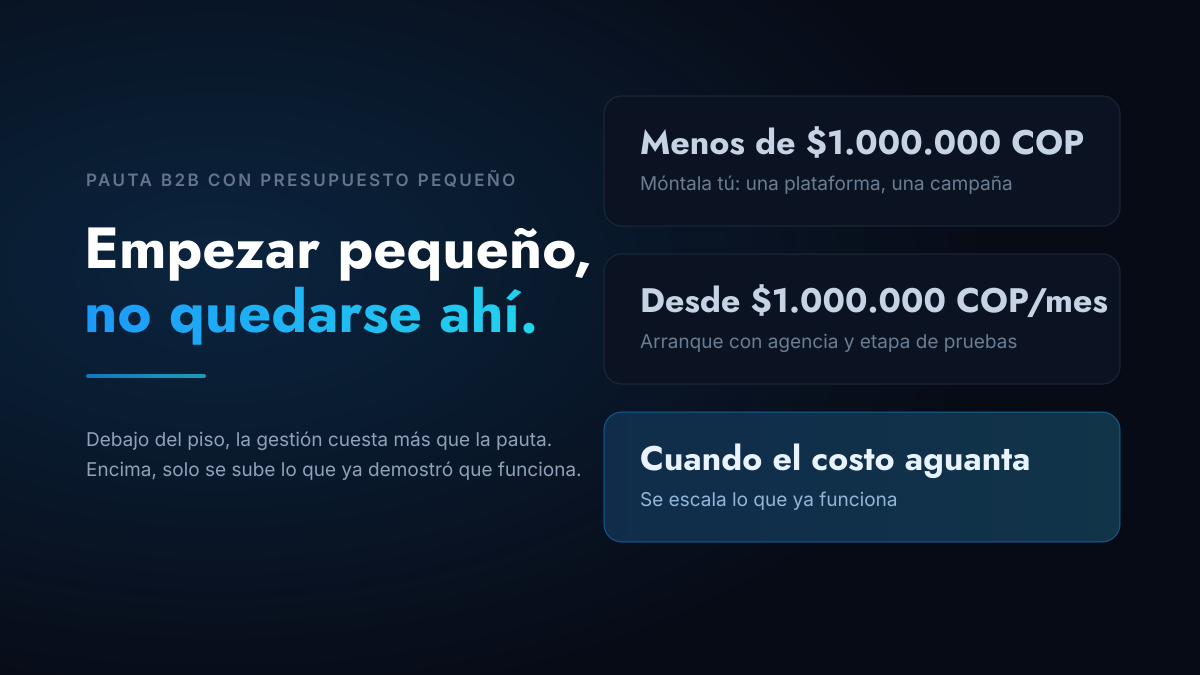
From around one million Colombian pesos a month in ad spend —about 330 dollars— and with the willingness to scale if the numbers hold. Below that figure the management fee weighs more than the advertising and it's better to run the campaigns yourself. And above any budget there's one condition money can't buy: someone who calls the lead the same day.
Why the floor is there and not at any other figure
The first reason is arithmetic. Whoever runs your advertising charges a fee that in Colombia sits, for services companies, in a known range —we break it down in what paid media management costs— and that fee doesn't drop because your spend is small: the work of setting up, measuring and optimizing is the same. If you invest COP 400,000 a month (about 130 dollars at the August 2026 rate), you're paying several times more for the management than for the ads. It isn't that it's overcharged: it's that the proportion can't be fixed, and the result would have to be extraordinary just to break even.
The second reason is technical and the platforms publish it themselves. Every campaign goes through a learning phase: until it accumulates a minimum rate of results —Meta talks about around 50 conversions per week per ad set— delivery is unstable and one day's numbers mean nothing. With small budgets that rate isn't reached in a week. It's reached by concentrating everything in one platform and one campaign, and judging by the month. Splitting a little across three channels is the fastest way to spend six months learning nothing; which one to go for first depends on how people buy from you, and it's in where to advertise depending on what you sell.
If you have less than a million: what to do instead of hiring
Run it yourself, and it isn't a consolation prize: with a small budget, a simple well-configured campaign performs better than a sophisticated campaign with a fee on top. The minimum you have to get right is three decisions —what objective the platform is set to, what data is captured and what counts as a valid lead— and they're explained step by step in how to build a campaign that brings customers. If you're already investing and what arrives is tyre-kickers, the diagnosis is in where the money is going.
We say this because it happens to us: when someone writes to us with COP 300,000 a month —under a hundred dollars— the honest answer is to start alone and come back to us when the numbers change. A client paying more for the management than for the advertising isn't going to be happy at three months, and rightly so.
Starting small isn't staying small
The first month isn't for making money, it's for finding out what converts: which message, which audience, which format and which offer. That's why the start is designed as a testing stage with a budget you can afford to lose without it hurting, not as a bet.
What decides whether you scale is a number of yours, not the agency's: how much you can pay for a new customer, and how many leads you need to close one. That's where your ceiling per lead comes from. When the cost per qualified lead —the one your salesperson confirms is useful— settles below that ceiling, raising the budget stops being a risk and becomes arithmetic. Scaling is that: putting more money behind what has already proven it works, not opening three new fronts because the month went well.
| You can raise the budget | Not yet | |
|---|---|---|
| Cost per qualified lead | Below your ceiling, and stable for several weeks | It rises every time the spend goes up |
| Quality | Your salesperson confirms they fit the profile | They arrive, but nobody can attend to them |
| Source | You know which ad and which audience brought them | They arrive, but nobody knows from where |
| Capacity | There's someone to call the same day if twice as many arrive | Leads are already going unanswered |
| The rule | You scale what you already understand. Raising the budget on something that worked without knowing why is the most expensive way to find out it was luck | |
The fourth row is the most forgotten: the bottleneck for a B2B small business is almost never the advertising, it's how many conversations it can sustain per week.
How the plan is built before the first campaign is switched on
A B2B advertising campaign that starts with no research is a bet with someone else's money. Before setting anything up, what we do —and what anyone worth the fee should do— is understand who needs to be reached:
- Who decides and who influences. In B2B it's almost never one person: the one searching isn't always the one signing, and the ad speaks to one of the two.
- Where they are and what they consume. Which platforms they spend time on, what content they open, what format they tolerate. A plant manager isn't the same as a marketing director.
- How they search once they have the problem. What they type into Google, in what words, and what they ask artificial intelligence today: more and more of that search starts in a chat and ends in a shortlist of suppliers.
- How long the decision takes. A service contracted in a week and one that takes three months aren't advertised the same way, nor judged over the same period.
That last point has an uncomfortable consequence for anyone wanting results now: Bain found that the vast majority of B2B buyers end up buying from a company that was already on their list before they started looking. Advertising puts you in front of whoever is ready today; being on the list of those who will decide in three months is another front, and we work it separately —it's in why AI doesn't mention your company. Both are needed: the first pays this quarter's bills, the second makes next quarter's cheaper.
With that in place the plan is defined: which platform, which audiences, which angles get tested first and what each one is measured with. Then comes the testing stage —several messages, few audiences, budget split with judgment— and only when a combination appears that produces qualified leads at a cost that holds do you start to scale.
In B2B the lead isn't the sale: what has to be ready first
It's the part almost nobody quotes and the one that costs the most sales. Advertising delivers a lead; what happens in the following hours decides whether that was a sale or an expense. A classic Harvard Business Review study measured how long companies take to respond to a lead that arrives online, and the result still describes what we see:
Audit of 2,241 companies · Harvard Business Review. In the same work, those that made contact within the first hour were nearly 7 times more likely to qualify the lead than those that waited an hour longer. Nearly one in four never responded — and they paid for the advertising all the same.
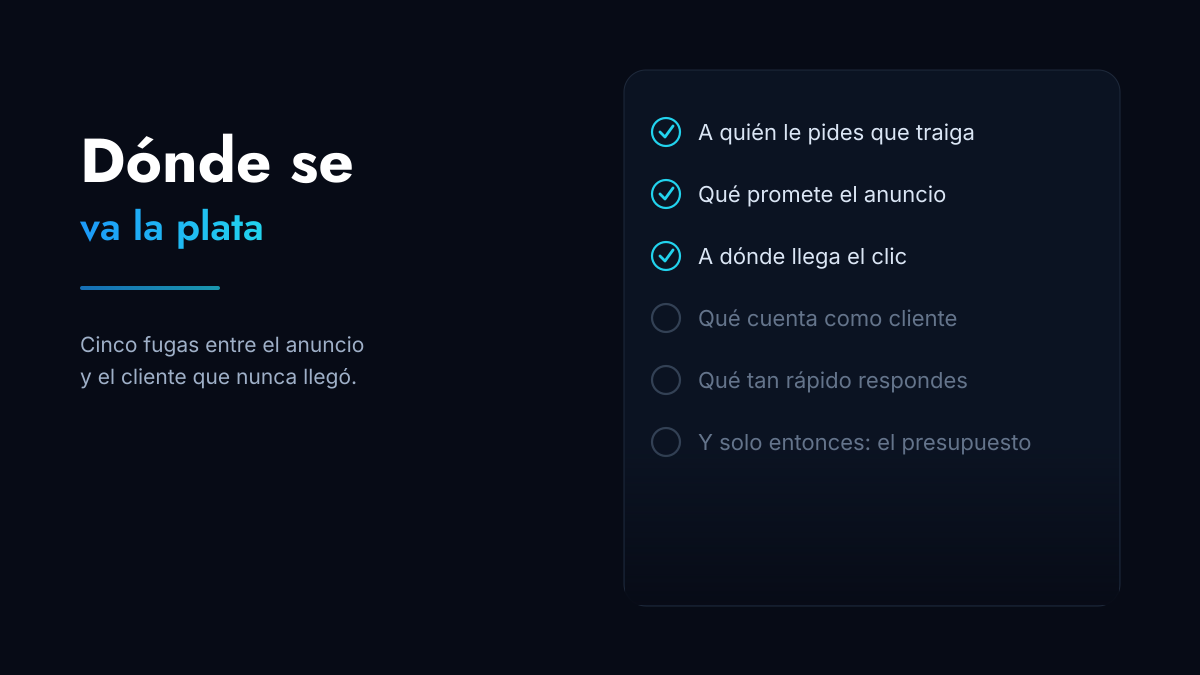
That's why, before switching on the first campaign, we review five things with the client. None is optional and none is expensive:
- An offer that's understood in ten seconds. What you solve, for whom and what happens if they contact you. "Free quote, no obligation" is not an offer.
- A page to land on. Your site works if it already converts; if not, a campaign page is needed. It's the difference between paying for visits and paying for leads.
- Someone to call, and promptly. With a name, and with an agreed deadline. The best lead of the week goes cold in an afternoon.
- A place for the lead to land. At the start a shared spreadsheet is enough; a CRM is justified when the volume makes doing it by hand start to fail.
- An answer for what arrives out of hours. Leads come in at night and at weekends. An automation that confirms and books, or an artificial intelligence agent that holds the first conversation, avoids losing the person who asked on a Saturday.
If those five aren't in place, the result is predictable: the advertising works, the leads arrive, the sales system fails and in the month-three report the conclusion is that "advertising doesn't work".
What happens in the first weeks
The other half of the question is the hurry, and it's legitimate. Worth separating what takes days from what takes weeks:
- Days. Account access, measurement installed and verified, a written definition of what counts as a valid lead, first campaign set up. The first leads usually appear in the first week.
- Weeks. Judging whether it works. Not out of someone else's impatience: the campaign needs to accumulate enough results for chance not to be in charge, and with small budgets that takes longer. Switching a campaign off after four days is throwing away the money already spent on learning.
- Month one. The decision isn't "does it work or not", it's which of the tested combinations stays and which gets switched off.
Why almost every agency asks for three months
It's one of the first things that appears in a proposal and it usually reads as a commercial lock-in. Sometimes it is, but the underlying reason is real: three months is the time it normally takes to go from switching campaigns on to having an optimized account and a scale-up that doesn't collapse when the budget goes up.
- Month one: set up and test. Structure, measurement, first ads and audiences. Leads come out, but the numbers still move a lot from one week to the next.
- Month two: optimize on what was learned. What didn't work is switched off, the budget is concentrated on what did, and the message and the filter are refined. This is where the cost per lead usually starts to come down.
- Month three: stabilize and scale. With enough data the spend can be raised without the cost per lead shooting up, which is the proof that what worked wasn't luck.
Judging the work at month one is like evaluating a new hire in their first week: you see the effort, not the result. And with small budgets the clock runs slower, because the data arrives more slowly.
That said, a minimum term is only reasonable if it comes with three conditions, and they're worth demanding before signing: that the accounts and the data are in your name, that there's a monthly report you can make decisions with, and that when the term ends you can leave without penalty. Six- or twelve-month lock-ins with the accounts in the agency's name are a different thing: that no longer protects the learning, it protects the supplier's billing. The other things worth demanding before signing are in the signs that advertising is being badly run.
We ask for that three-month horizon to judge the work, not to tie you down: the accounts are yours from day one, so if you decide to stop you take the account, the measurement and everything learned with you.
How we do it at Statum Digital
The first thing we deliver isn't a campaign. It's a written definition, made with your sales team, of which lead is useful and which isn't, and the installed measurement that verifies it. From there we test, and the budget only goes up on what has already brought leads your sales team confirmed. The accounts are in your name from day one.
The goal isn't to bring leads: it's to reach the point where a qualified lead costs considerably less than what a new customer leaves you. If you already have the minimum budget to start and you want real leads coming in this quarter, tell us your case in the form: what you sell, to whom and how much you're thinking of starting with. With that we'll tell you whether it suits you and where to start. And if you'd rather ask first, on the managed paid media service the rates are published and Diana, our sales executive, answers questions right there.
Frequently asked questions
What's the minimum spend for hiring an agency to be worth it?
More than an absolute amount, it's a proportion: if the management fee weighs more than what goes to the platforms, the numbers don't work for either side. Our practical reference is one million Colombian pesos a month in spend —about 330 dollars— as a starting floor, with the intention of raising it as the numbers justify. Below that it's better to run the campaigns yourself.
Do I have to sign a minimum term?
Almost every agency asks for a minimum of three months, and the reason is reasonable: that's the time it takes to go from setting up campaigns to optimizing and scaling them with enough data. What is worth checking before signing is that the accounts are in your name, that there's a monthly report and that when the term ends you can leave without penalty. Long lock-ins with the accounts in the supplier's name are a different thing.
Can I start with less and go up later?
Yes, and that's what we recommend doing alone: set up a simple campaign yourself on a single platform, learn with it and keep the data. When the spend reaches the floor, that history is worth something: the account already has measurement, there are ads that have been tested and you don't start from zero.
Google or Meta for B2B lead generation in Colombia?
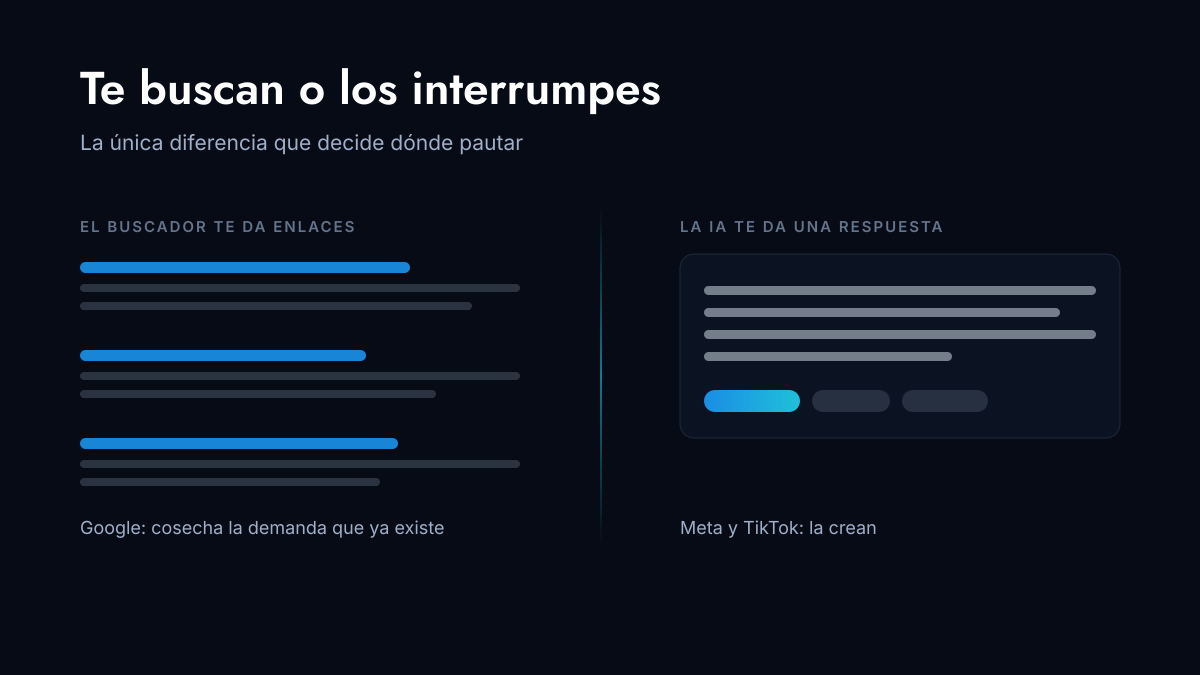
It depends on whether your customer already knows they have the problem. If they're actively searching for it, Google gets there sooner and with more intent. If they aren't searching yet, Meta lets you get in front of them by profile and behavior at a lower cost. With a small budget you pick one, not both: splitting a little between two channels delays the learning on both.
How long until the first leads arrive?
Setup and measurement take days, and the first leads usually appear in the first week. Judging performance is another matter: that requires the campaign to accumulate enough results for chance not to be in charge, and with small budgets it can take several weeks.
Do I need a CRM from the start?
No. A shared spreadsheet where the salesperson marks which lead was useful and which wasn't already gives you the most important figure, which is how many of the paid leads were real. The CRM is justified when the volume makes doing it by hand start to fail, not before.
Is an artificial intelligence agent useful for handling leads?
It's useful for what a human can't cover: responding immediately, at any hour, confirming interest and booking. In B2B it doesn't replace the sales conversation —the decision-maker wants to talk to someone— but it stops a Friday-night lead going cold until Monday, which is where a good part of what was paid for gets lost.
What if my problem isn't getting leads but closing them?
Then advertising isn't the first thing. If leads of the right profile arrive and don't close, the issue is in the offer, the price or the sales process, and putting more budget into advertising only multiplies the problem. Better to fix the closing with the current volume and scale after.
Does AI name your brand?
Enter your domain and we tell you in seconds whether AI already recognizes your brand, and what your site is missing for the engines to read you.
Free, in seconds, no signup.