Advertising for leads, not followers
"We've been advertising for months and not one customer has come in." It's almost never bad luck: the campaign was configured for something else and the platform delivered to the letter.
There's a line you hear in a lot of management meetings: "we've been advertising for months and not one customer has come in". It's almost never bad luck, or the wrong network. It's that the campaign was configured for something else —reach, engagement, messages— and the platform delivered to the letter. If it was never configured to bring customers, there's no reason it should have brought any.
The short answer: how to build a campaign that brings customers
With three decisions made before spending: configure the campaign for conversions and not for engagement, capture enough data for your salesperson to be able to call, and agree what counts as a valid lead. With that, even a small budget starts producing real leads instead of comments.
Why a campaign configured for movement doesn't bring buyers
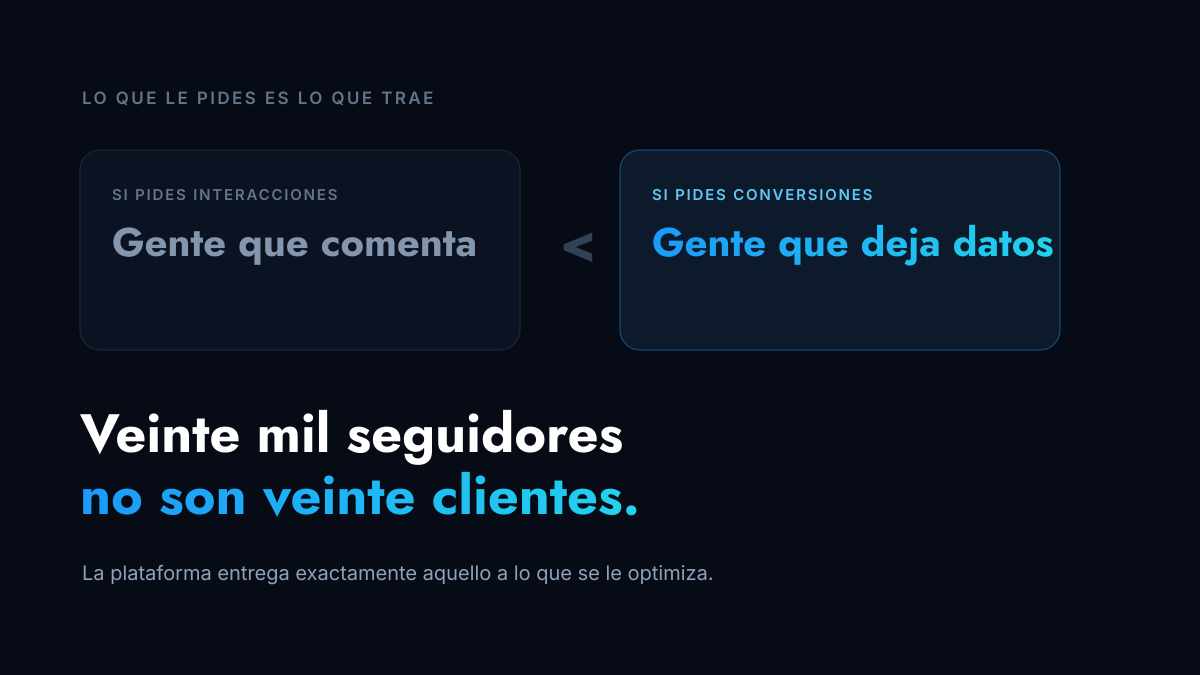
Ad platforms work by objective: you tell them what result you're after and they go out to find the people most likely to give it. That choice decides who your ad is shown to, more than targeting by age or interests.
If the objective is engagement, the system looks for people with a history of commenting and reacting. It finds them and brings them, and the report looks spectacular. If the objective is conversion, it looks for people with a history of leaving their details or buying. It brings fewer people, each one costs more, and even so the customer usually comes out cheaper. It's counterintuitive, and it's the reason why comparing campaigns by cost per lead leads to the wrong decision.
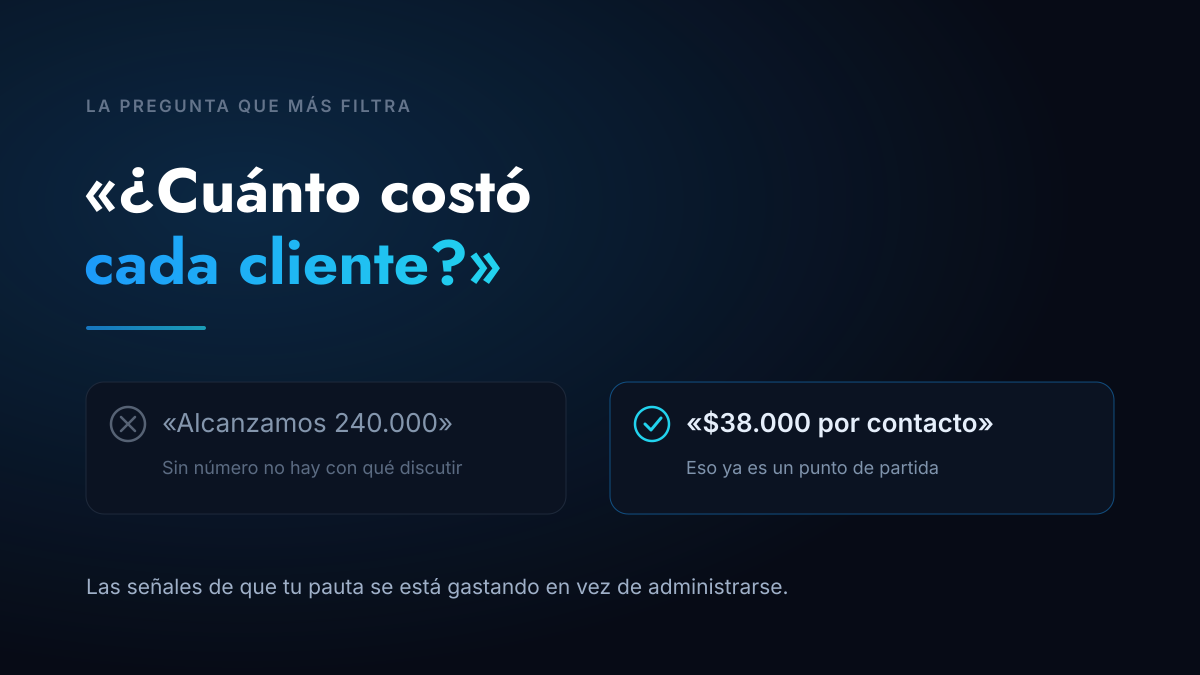
The long bar isn't the good one. What matters isn't how many people arrived, but how many could buy from you: that's why the cost per lead, looked at on its own, is the number that has caused the most bad decisions in digital advertising.
The three decisions made before spending
1. What objective you set the platform
Conversions — what measurement tools call key events. And for the system to be able to look for them, it has to be able to see them: the tracking that tells it every time someone leaves their details has to be installed. Without that, the campaign optimizes blind however much the objective says "conversion".
2. What data you capture
The minimum for your salesperson to do their job, not the maximum. Asking for too much scares people off; asking for too little brings leads nobody can call. In services, the balance usually sits at name, phone, company and one question that filters — size, need or urgency.
That filtering question does double duty: it sets aside whoever doesn't fit and gives your salesperson the first line of the call.
3. What counts as a valid lead
Agree it beforehand, not when the first report arrives. A completed form isn't a lead if the phone number is mistyped or if the person was asking for something you don't sell. Defining it changes two things at once: what gets reported, and who the system goes out looking for the following month.
Where the lead can land: it isn't all a form on your site
Once it's decided the campaign goes for conversions, what's left is choosing where the person lands. The platforms offer several doors and they all count as a lead if the tracking records them — which is what lets the system go out looking for more people like the ones who already left their details.
| Where it lands | What it gains | What it costs |
|---|---|---|
| Form inside the ad | Meta and LinkedIn open it without taking the person out of the network and with the data pre-filled: more leads and cheaper | They arrive less committed. If nobody calls the same day, they go cold |
| Your own page | It filters: whoever filled in the form made an effort and arrives more decided | Every second of load time costs you people, and someone has to build the page |
| Direct message | WhatsApp, Messenger or Instagram: a conversation from the first minute, and in Colombia it's the most natural door | If the campaign is optimized for "messages", plenty arrive who only ask for prices |
| Call | The warmest lead there is: the person already wants to talk | Requires someone to answer during opening hours, always |
| Booking | The lead arrives with a date and time already in the salesperson's calendar | Only works if your service is sold in a meeting |
None is better in the abstract. The practical rule: the easier it is to leave details, the more leads and the less commitment. In high-ticket services the page or the booking usually suits; at volume, the in-ad form or the direct message.
The message case deserves a clarification, because it's where most money is lost in Colombia: a message campaign can be configured so the conversion is the click that opens the chat —and then hundreds arrive who ask for prices and disappear— or so it's the conversation that progresses and leaves details. It's the same channel and the same budget; all that changes is what it was asked to measure.
What budget you can start with
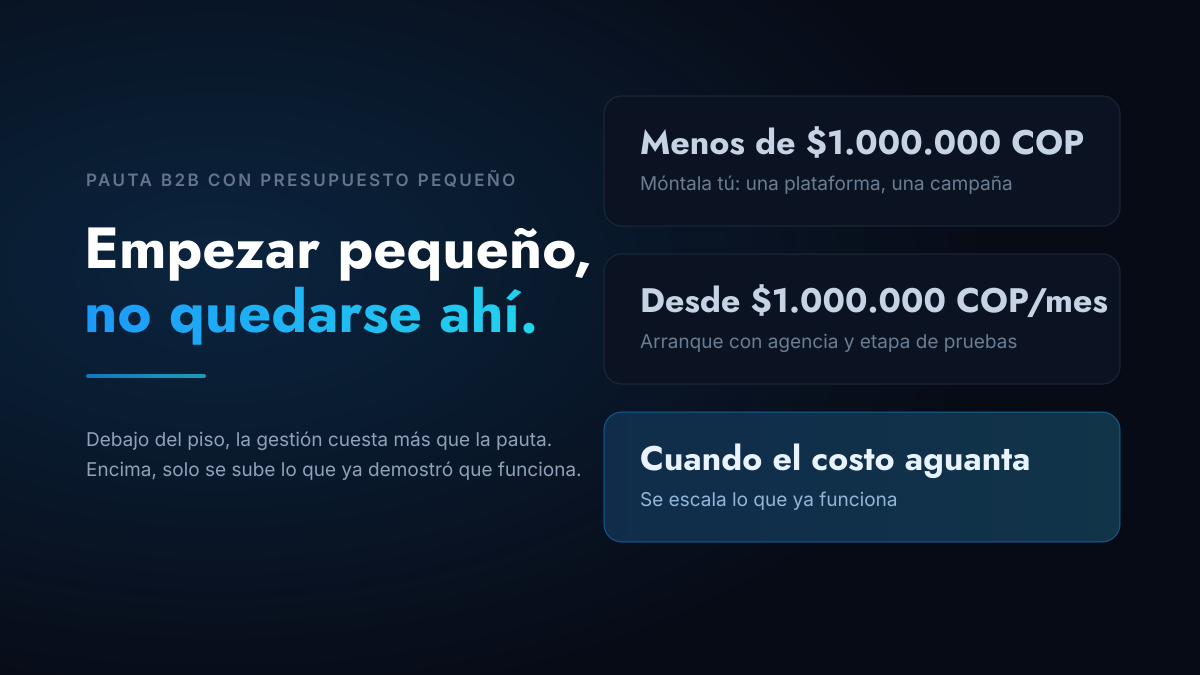
With less than is usually said, as long as two conditions hold: one platform and one objective. The expensive mistake isn't starting small, it's splitting a little across three channels — that way none accumulates enough data to optimize and six months later nothing has been learned.
The calculation that tells you how much you need is yours and is made with three numbers: what a new customer leaves you, how many leads it takes to close one, and from there how much you can pay per lead. It's worked through in what paid media management costs in Colombia. And which platform to start on depends on whether your customer is already searching for you or the need has to be awakened: that's in where to advertise depending on what you sell.
What to watch in the first weeks
- How many leads arrived and what each one cost. The starting point, not the goal.
- How many of those your salesperson qualified. It's the number that really matters and the only one the platform can't give you.
- Which ad brought them. Almost always a few do most of the work: that's where the budget gets concentrated the following month.
- How fast the reply went out. In services, responding in minutes instead of days changes the result without costing a peso more in ad spend.
And separating the two things usually mixed up: the setup takes days, but judging whether it works takes weeks, because the campaign needs to accumulate enough results for chance not to be in charge. With small budgets, a bit longer.
So are followers worth nothing?
They're worth something, but for something else and over a different timeframe. Bain found that a good part of the decision is cooked before the first contact: there an audience of your own carries weight, even if it doesn't close on its own. An audience of your own makes future advertising cheaper —speaking again to someone who already knows you always costs less than reaching a stranger— and sustains trust when someone is evaluating you. What they don't do is close sales by themselves. And you don't need a separate campaign to get them: a well-built sales campaign leaves them along the way, because whoever sees the ad goes into the profile and stays. The reverse almost never happens, and there's the answer as to where to put the budget.
If the objective is to be found and recommended when someone asks about what you sell, that's a different front from paid advertising and it's worked separately: it's in why ChatGPT doesn't mention your company.
How we do it at Statum Digital
In our managed paid media service the first thing we deliver isn't a campaign: it's a written definition, made with your sales team, of which lead is useful and which isn't, and the installed tracking that verifies it. From there we advertise on whichever platforms apply, with the accounts in your name and with a monthly review alongside your sales team. What to demand from anyone running this is in the signs advertising is being badly run.
So if what you want is real sales leads —not movement on the profile— and you already have the minimum budget to start, tell us your case in the form: what you sell, to whom and how much you're thinking of starting with. With that we'll tell you what spend makes sense to start with and what has to be ready before switching on the first campaign. And if your case doesn't yet justify hiring anyone, we'll tell you that too: from what point it's worth it is in B2B paid media on a small budget.
Frequently asked questions
Is a form inside the social network better, or sending them to my site?
The form inside the platform brings more leads and cheaper ones, because the person doesn't have to leave or wait for anything to load; in exchange, they tend to arrive less committed. Your own page filters more and gives better leads, but every second of load time costs you people. In high-ticket services the page usually suits; at volume, the form.
What if I only want people to message me on WhatsApp?
You can, and it works well for certain businesses, with one warning: if the campaign is optimized for "messages", you'll get plenty and mostly from people who only ask for prices. If the tracking is connected so the conversion is the conversation that progresses, and not the click, the same channel starts bringing a different kind of person.
How many leads should I be getting?
There's no correct number in the abstract: it depends on what your customer is worth and how much you spend. A business billing millions per customer can live on five leads a month; a low-ticket one needs hundreds. That's why the first number you need is your own business's, not an industry average.
Is giving something away —a guide, an audit— useful for getting leads?
It's useful when what you give away only interests someone who could buy from you. A generic guide attracts everyone and fills the list with people who will never hire you. The more specific and the closer to the buying decision, the better the lead quality, even if fewer arrive.
Do I need a separate campaign to grow on social media?
Today almost nobody advertises to get followers, and it makes sense: a well-built sales campaign already leaves them along the way. If you still want to push profile growth, it's done in a campaign with its own budget and never mixed with the sales one: the system can only chase one objective properly, and that way you also see which is doing what.
What do I do with the leads that didn't buy?
Keep them and re-reach them. They're the cheapest list you'll ever have: they already know you and they already raised their hand. In services with a long cycle, a good part of the quarter's sales comes from leads that arrived the previous quarter.
Do I need a CRM for this?
Not at the start: a shared spreadsheet where the salesperson marks which leads were useful already gives you the most important figure. The formal system is justified when the volume makes doing it by hand start to fail, not before.
Does AI name your brand?
Enter your domain and we tell you in seconds whether AI already recognizes your brand, and what your site is missing for the engines to read you.
Free, in seconds, no signup.