How much a corporate website costs in Colombia
Three quotes for the same project, millions apart, all saying more or less the same thing. What is being paid for in each case, what moves the price, and how to compare two proposals without getting it wrong.
You're putting together the year's marketing budget and you need a figure for the "website" line. You ask for three quotes on the same project and they come back millions apart, all saying more or less the same thing. Before deciding on price it's worth understanding what's being paid for in each case, because the difference is almost never the design.
The short answer: what you pay for and how much
You pay for three different things: building the site, keeping it running every month, and the domain with the hosting. The first is what varies most, and it varies by scope: a single page doesn't cost the same as a ten-page site or a store. At Statum Digital a One Page starts at COP 1,500,000 and a multi-page site at COP 3,500,000. If you're going to sell online, a store starts at COP 4,200,000 and goes up depending on the platform and what you want to demand of the buying experience.
Maintenance is separate and starts at COP 120,000 a month depending on the type of site. And the domain with the hosting is a small annual cost compared to the rest, but it comes with one non-negotiable condition: it has to be in your name.
| What it is | What it's for | From |
|---|---|---|
| Landing Page | A page inside the site you already have, for a specific campaign | COP 700,000 |
| One Page | A complete site of your own on a single page, with domain and hosting | COP 1,500,000 |
| Multi-page Website | Up to 10 pages. The standard option to present the company | COP 3,500,000 |
| High-Performance Website | Near-instant loading, blog and content manager, ready for AI to cite you | COP 5,000,000 |
| WordPress E-commerce | Your own store, with no platform commissions and no product limit | COP 4,200,000 |
| Shopify E-commerce | A store on Shopify, with no back-end maintenance to worry about | COP 6,000,000 |
| High-Performance E-commerce | An ultra-fast storefront on the Shopify engine, for stores that already sell | COP 9,500,000 |
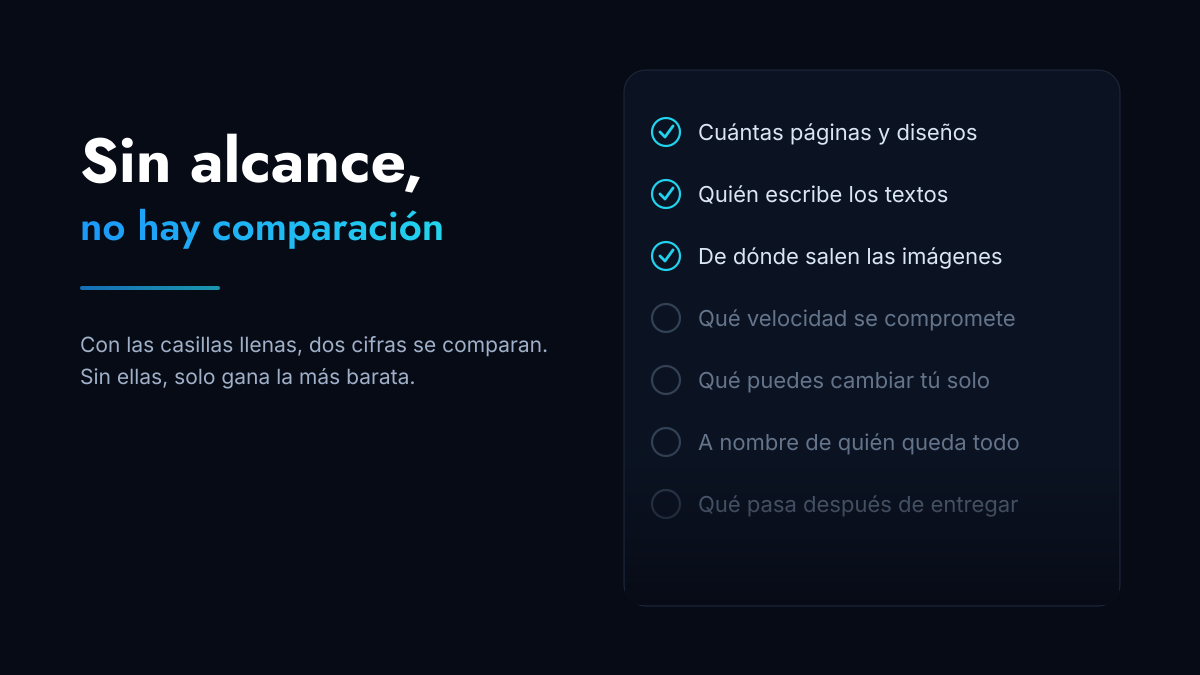
We publish them on purpose, like the ones for our other services. A quote that doesn't state the scope can't be compared to anything: the number only means something next to how many pages, who writes the copy and what happens after delivery.
What moves the price from one quote to another
- How many pages and how many different layouts. Repeating one design ten times isn't the same as designing ten different pages. It's the heaviest factor and the one that's almost never itemized.
- Who writes the copy. If the supplier writes it —these days almost always with AI involved— the project moves on its own and you come in to review and approve; if your team has to write it, the schedule hangs on someone's calendar. Neither option is better, but the one that wasn't agreed on is the one that stalls the project for three months.
- Where the images come from. Stock libraries, pieces generated for your brand, your own material or a professional photo shoot: each option changes the price and, above all, changes how much the site looks like your actual company.
- How fast it has to load. Meeting the thresholds Google uses to measure experience —the Core Web Vitals— requires building differently, not just pressing a button at the end.
- Whether it sells or captures leads. A store adds payments, shipping, inventory and purchase testing. It's a different project, not the same one with an extra button.
- Integrations. Connecting the form to a CRM, booking appointments, syncing inventory or installing a WhatsApp bot is separate work and should be quoted as such.
The three costs that show up later, and that almost nobody asks about
This is where it's decided whether the site was cheap or only looked it.
Maintenance. Updates, backups, security and support when something breaks. On a site with a content manager this isn't optional: WordPress's own documentation insists on keeping the platform and plugins up to date, and that's where most of the avoidable scares live. In our case it starts at COP 120,000 a month for a One Page and goes up by type of site, to COP 500,000 for a WordPress store, which is the most demanding. An unmaintained site doesn't go down the next day: it goes down eight months later, and by then the cost is a different one.
Content changes. Changing a phone number, uploading three photos, adding a service. If you can do it yourself it costs nothing; if you depend on the supplier, it's billed by the hour — in our case COP 150,000 per webmaster hour. That's why it's worth asking from the start what you'll be able to edit without calling anyone.
The domain and the hosting. They're the smallest cost and the most important one to watch, because it's your address on the internet. They have to be in your company's name, with the credentials in your hands. When they're in the supplier's name, changing supplier stops being a technical decision and becomes an uncomfortable negotiation.
Why one quote costs COP 800,000 and another COP 8,000,000
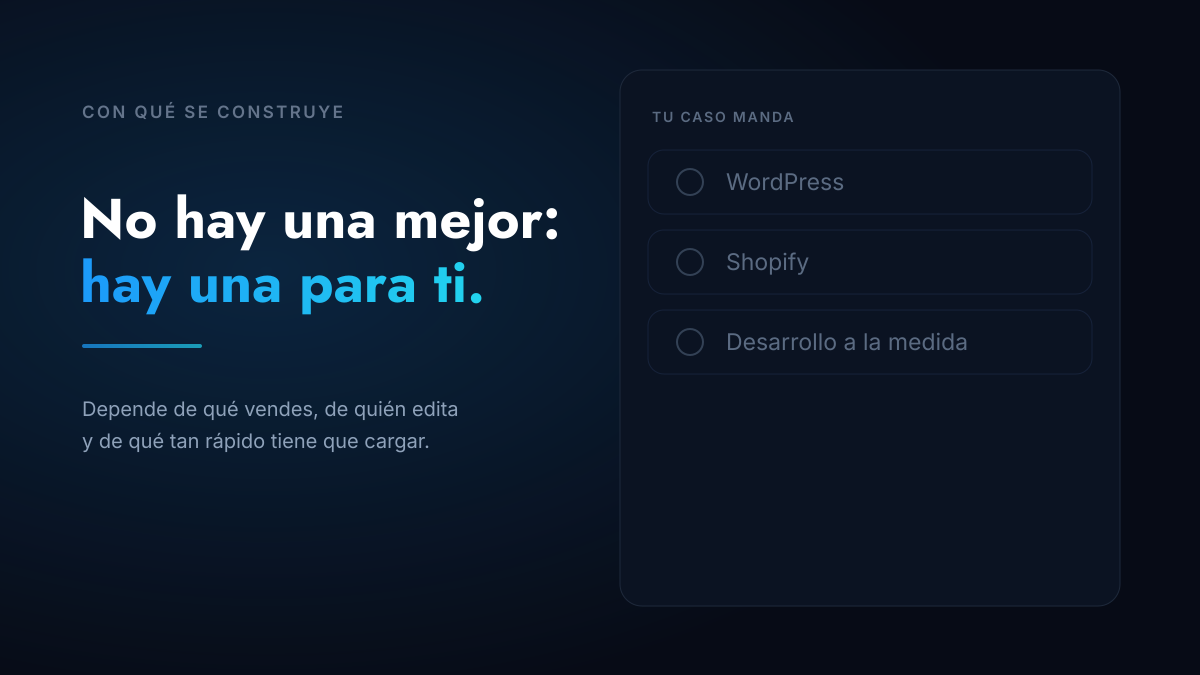
Because very different things are sold under the same name, and the Colombian market is especially scattered on this. At the low end there's usually a purchased template, filled in with your copy and published; it works, it looks decent, and its limit shows up when you want to compete for searches, when you need speed, or when something fundamental has to change. At the high end there's custom design, written content, measurement installed, integrations and support after delivery.
What matters isn't which one is cheaper but which one is right for you, and that depends on what the site has to do. If your page only has to exist to provide reassurance when someone searches for your name, the simple option is a sensible decision. If the page is the channel through which customers who don't know you today are going to arrive, then it's worth investing in speed, structure and content, because that's what will bring the money back.
And a practical warning: when the low price comes with the domain and hosting in the supplier's name, a site you can't edit and no access to the code, you didn't buy a cheaper website — you rented one that isn't yours. The signals for telling one from the other are in how to choose who builds your website.
How to work out how much it makes sense for you to invest
The figure doesn't come from comparing quotes, it comes from your own numbers, and it's reasoned in three steps:
- What a new customer leaves you. The profit, not the sale. And if your service renews, the profit over the whole time the customer stays with you.
- How many customers a year the site would have to bring you to pay for itself. With a high ticket it can be two or three. With a low ticket and volume, the maths is done with margin per sale and number of orders.
- What you're going to bring people in with. This is where many budgets break: everything is spent on building the site and nothing is left for anyone to come and see it. If you're going to use advertising, that investment is separate and should be budgeted alongside the site: read more on what paid media management costs in Colombia, where that calculation is worked through — which part is the management and which part the ad spend.
With those three answers the decision stops being "which quote is cheaper" and becomes "how much makes sense to invest for what I want to achieve", which is a question with an answer.
How to compare two proposals without getting it wrong
Put them in the same table and fill in these boxes: how many pages · who writes the copy · where the photos come from · what speed is committed to and how it's measured · what you can edit yourself · whose name the domain and hosting are in · what maintenance includes and what it costs · what a change costs afterwards · how long delivery takes and with what stages · experience: what sites they've built and how those behave today. The cheapest proposal is almost never the cheapest: it's the one that left three boxes empty.
How we do it at Statum Digital
We publish our rates because we think the conversation starts better with the cards on the table, and because a quote without a scope is no use to anyone. What we deliver for that price is on our web design and development service: custom design, a site built to load fast and to let search engines and artificial intelligence read it, measurement installed, and domain, hosting and credentials in your name from day one.
It's built by our team of specialists with years of development experience, with artificial intelligence built into the rest of our tools. That has two effects you feel in your pocket: what used to take months we deliver in days, and that saved time is part of why our rates are what they are. It isn't a stripped-down version of the work; it's the same work done with better tools.
One clarification worth keeping in mind when comparing prices: the site shipping built so search engines and AI can read it is the technical foundation and it's included. Showing up recommended in AI answers when your category is contested is a different investment, sustained over time, and it's budgeted separately — that's our SEO and GEO service. Folding it into the price of the website would be selling you smoke.
Need the figure for your budget? Tell us what your company does, how many pages you think you need and by when. We'll come back with a proposal with every box filled in and an honest recommendation of the scope that suits you — which is often smaller than the one you came asking for, and we'll tell you that too.
Frequently asked questions
Does VAT get added to these prices?
Not to building the site. In Colombia the supply of web pages and hosting is excluded from VAT under article 476, item 21 of the Tax Statute, so building your site is invoiced without that 19%. In tax language it's excluded, not exempt; for your budget it means the same thing: it isn't added. Maintenance does carry it —the exclusion that covered it was removed by Law 1943 of 2018— so count it in from the start if you're going to contract it. In the proposal each line is marked accordingly, and your accountant can confirm it in a minute.
Can it be paid in instalments?
That's the norm in development projects: a deposit to start and the rest against deliveries. What's worth avoiding is paying the full amount up front before having seen anything, and also the opposite: a project with no deposit tends to be the first one pushed back when the supplier gets busy.
How long does a website last before it has to be rebuilt?
A well-built, well-maintained site lasts years without rebuilding; what gets renewed is the content. What shortens a site's life usually isn't design fashion but neglect: with no updates, no new content and nobody looking at the measurement, after two years it no longer represents the company. Renewing content costs far less than rebuilding.
Is it worth paying more for a high-performance site?
It depends on whether you're going to compete for attention. If most of your customers arrive through referrals and the page only confirms you exist, the standard option is enough. If you're going to invest in advertising or in ranking, speed and structure stop being a luxury: they're what makes that investment pay off, because every second of load time takes away people you already paid to bring in.
Does the price include the copy and the photos?
Yes, with a clear split. We write the copy with AI support: we don't expect you to hand us a written page. What we need from you is the information only you have —what your company does, what you sell, what makes you different, who you're talking to— and the style and tone you want your brand to sound like; from there you review, request adjustments and approve. Images and video work similarly: you can give us your own material, and if you don't have it we use stock libraries or generate the pieces with AI. What isn't included is professional photography or video production: if your case calls for them, they're quoted separately.
What if I need the site in less than a month?
It's perfectly possible and it shouldn't cost more for being urgent. What does have to be secured is what depends on you: your company's information, any of your own material you want to use and, above all, approvals on time. With that sorted, delivery is counted in days. When an urgent project slips, in most cases it wasn't the development, it was a review waiting for an answer.
Does AI name your brand?
Enter your domain and we tell you in seconds whether AI already recognizes your brand, and what your site is missing for the engines to read you.
Free, in seconds, no signup.