How to choose who builds your website
Three quotes saying the same thing and millions apart. What to ask for in writing so they finally become comparable, and the signals that tell you you're in good hands from the first meeting.
You asked for three quotes to rebuild the company site and all three say more or less the same thing: custom design, mobile-friendly, search engine optimized. The prices are millions apart and you have no way of knowing what explains the difference. The good news is that you can know, and you don't need to understand code: you need to start with the objective and ask in writing for five things that verify themselves.
The short answer: what to ask of whoever builds your site
Five things, in writing: that the domain and the hosting are in your name, that the speed is committed to with a public measurement, that you can update your content without calling anyone, that the page is built for people to contact you or buy from you, and that on delivery you get every credential along with a session to teach you how to use them.
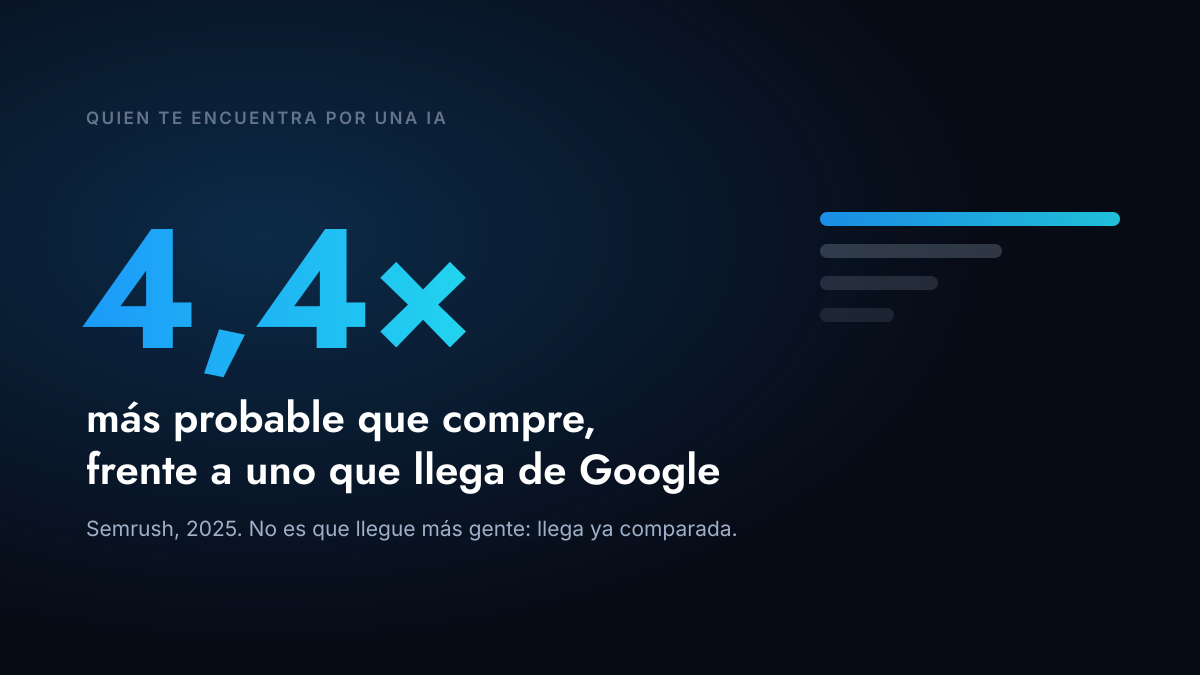
And a sixth that rarely appears in proposals and matters today: that the site is built so search engines and artificial intelligence assistants can read it and cite it. More and more customers arrive because an AI sent them, and that depends largely on how the page is made. We work through it in websites AI can read and cite.
Asking for these six things doesn't make the project more expensive. What it does is finally make the three quotes comparable to each other.
The objective first: leads or sales?
It's the question that organizes everything else, and the one worth settling before looking at designs. A site chasing leads and a store chasing sales are built differently, measured differently and cost differently.
- If you sell services or sell to companies, the objective is for the right person to quickly understand whether you're for them and to have somewhere to write to you. The build decides whether the message reads in the first few seconds, whether there's a clear action on every screen and whether the form works and reaches the salesperson's inbox.
- If you sell products online, the objective is making buying easy. Here come things that don't even exist on a corporate site: a catalog that can be searched and filtered, product pages with what's needed to decide —photos, variants, availability—, the shipping cost visible before the last step, and payment tested end to end on a phone.
Many companies need both at once —a storefront that sells and a site that captures large projects through direct contact— and that's also planned from the start. What doesn't work is deciding it halfway through: the page structure comes out of the objective, not the other way around.
And there's a part that doesn't depend on the supplier but on you, which is the one that moves the final result most: the clearer you arrive, the better the site they'll deliver. You don't need to bring a design in your head or know about technology. You need to bring this:
- What kind of site you need and what it has to achieve. Whether it's for people to contact you, to sell online or both, and what you expect to happen when someone comes in.
- Which features are non-negotiable. Bookings or appointments, a catalog with variants, a quote calculator, a private client area, several languages, or a connection to your invoicing system or your CRM. Said beforehand, it's part of the design; said afterwards, it's redoing work.
- The style and tone you use with your customer. Warm or institutional, restrained or with more color. It's a brand decision and you make it, not the designer.
- References, well chosen. If you're going to share a site you like, make it a good one and say what you like about it: the structure, the clarity with which it explains the service, how it shows prices. "Make me something like that" gets interpreted ten different ways; "I like how this one explains its service in three blocks" gets executed with no margin for error.
That half hour of clarity before asking for quotes pays for itself: it's the difference between receiving a proposal designed for your company and receiving three generic budgets you then have to correct on the fly.
What "high performance" means and how it's verified
It's the most repeated promise and also the easiest to verify, because it doesn't depend on anyone's opinion. Google publishes three user experience measures —the Core Web Vitals— and anyone can run them for free on any site in PageSpeed Insights. The one that matters most is the first: how long the main content takes to appear. The threshold Google considers good is 2.5 seconds on mobile.
With that in hand you have a much easier conversation, and a single request that sums it up: "let's measure it together right now". Ask whoever is quoting you to open the tool in the meeting and measure one of their own sites that's already live, with its photos and its content loaded. It takes thirty seconds and tells you more than half an hour of presentation. And for your project, the question that closes the point: "what number does mine ship with?". Get it written into the proposal.
This matters in money, not just in technique. In an online store speed weighs directly on sales: every second of waiting takes away buyers who had already decided. On a services site it takes away visitors you paid to bring in, with advertising or ranking, and it's the quietest leak of all because it doesn't show up in any report.
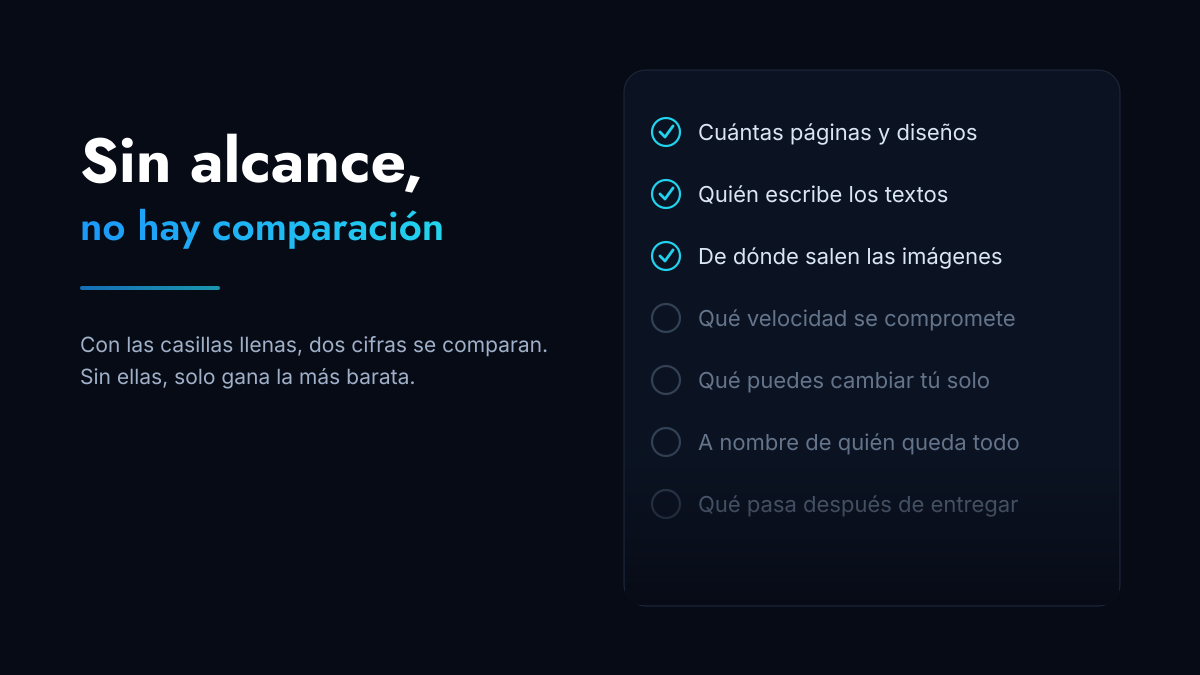
| Point | What to ask for | What you gain |
|---|---|---|
| Domain and hosting | In your company's name, with the credentials handed over | Your address on the internet is yours, and changing supplier whenever you want is paperwork and not a negotiation |
| Speed | The committed number and the tool it's measured with | A promise that gets verified on delivery day, with no argument in between |
| What you edit | The list of what you can change without calling anyone | Changing a phone number, a price or a photo the same day you need to |
| Content | Who writes the copy and who sources the photos | A schedule that holds: it's what weighs most on the delivery date |
| Measurement | Analytics installed and the form tested end to end | Knowing from day one whether the site is working |
| If you sell online | Payments, shipping and the checkout tested with a real order | Opening while selling, instead of discovering the problem with your first customer |
| Delivery | Credentials, a backup and a session to teach you how to use it | A site you can keep alive yourself, not one that ages in three months |
The cheapest proposal almost never ends up being the cheapest: it's usually the one that left three of these boxes blank. Asking for them complete is what makes three quotes comparable when today they aren't.
How to recognize you're in good hands
None of these signals requires you to know about development. They all show up in the first meeting or by reading the proposal.
- The first question is about the objective, not the sections. If the conversation starts with "who do you sell to and what do you want that person to do", you're on track: that's where a site that works comes from. If it starts with "how many sections do you want", what you're going to get is a brochure on a screen.
- They put the domain and the hosting in your name from day one. Without you having to ask, and with the credentials handed over in writing.
- They give you a schedule with stages and tell you what depends on you. When you see the design, when you hand over the copy, when the review happens. A good share of the timeline depends on the client's side, and knowing that from the start is what makes the date achievable.
- They show you sites that are live and measure them with you. Not just design images: real sites opened on a phone, which is where people actually browse.
- They tell you what it costs to build and what it costs to maintain. They're two separate charges: the site is paid once, and maintaining it —updates, backups and support— is paid monthly. When you see both figures from the start, you know what you're getting into.
- They commit to the technical foundation, not a position on Google. Nobody controls the search engine. What can be committed —speed, structure, content that's readable for search engines and for AI— is exactly what sustains ranking afterwards.
What you'll be able to change yourself
It's the question that gives the most peace of mind and the one least often asked. The right answer isn't "everything": it's a clear list, stated before signing.
On WordPress and Shopify you manage from the usual panel: copy, photos, products, prices and blog posts. On a high-performance site you get a content manager where you edit copy, images and articles without touching code, and where the data that changes with the life of the company —phone, WhatsApp, email, address, hours— sits as fields you update yourself in a minute. It's worth asking for that explicit list in the proposal: it's the difference between correcting a contact number today or waiting until someone has a moment.
What you normally won't do on a high-performance site is redesign pages by dragging blocks, and it's worth knowing that up front. In exchange, the design doesn't fall apart over time and the site doesn't get slow through accumulated plugins. If building your own pages matters to you, that points to WordPress and it's a healthy conversation to have before signing, not after: the full comparison is in WordPress, Shopify or custom development.
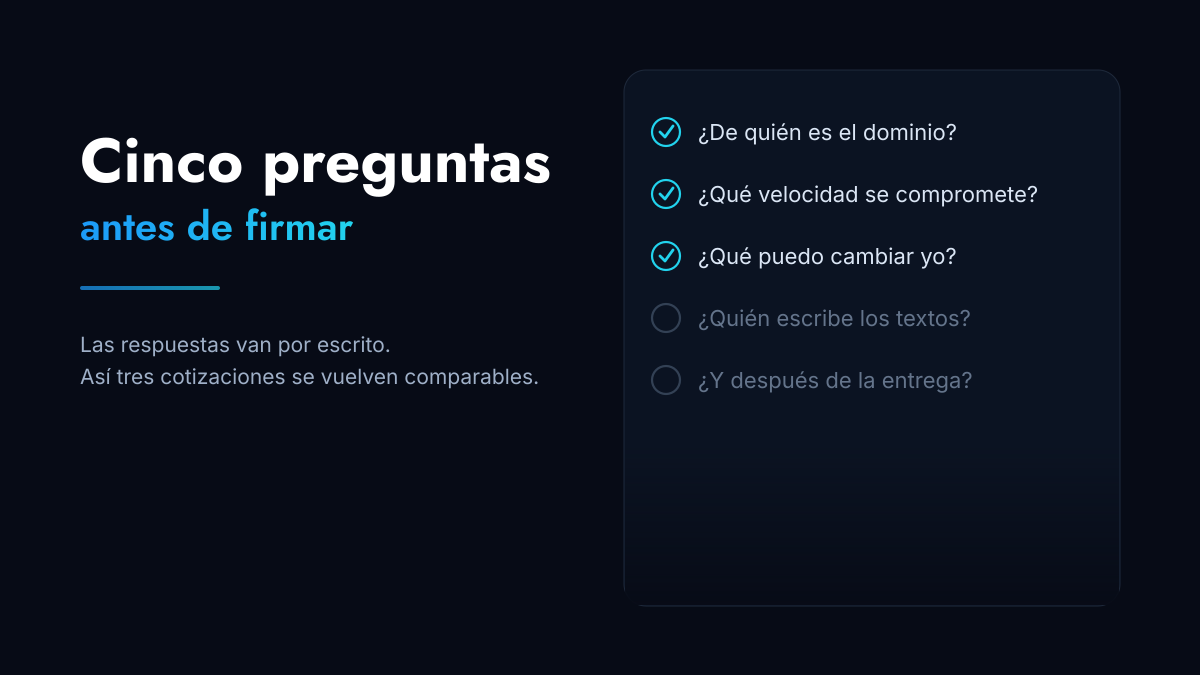
The five questions worth asking before signing
- Whose name do the domain and hosting go in? The right answer is "yours", with no qualifiers.
- What speed is committed to and how do we measure it? Get the number and the tool, and make sure it can be verified on delivery day.
- What can I change without calling anyone? Get the list in writing: copy, photos, articles, contact details and —if you sell online— products and prices.
- Who writes the copy and who loads the catalog? If it's your team, count that time in the schedule. If it's the supplier, make sure it's in the price.
- What happens after delivery? Who updates it, who responds if something goes down and what a change costs.
These questions work for any marketing supplier, not just whoever builds your site. If you're also looking for someone to run your advertising, we wrote the ones that apply there in how to choose who runs your paid media. And if you already have a new site and nobody is coming, see new website and nobody is coming.
How we do it at Statum Digital
We start by understanding your business and what you expect from the site: who you sell to, what you want the person who comes in to do and what sets you apart from your competition. With that we design and develop a site built around your objectives and the image you want to project, made to work for your brand every day: to present you with the weight your company has and turn visits into leads for your sales team or into sales. When the objective is selling online, that same work goes into the catalog, the product page and the checkout, which is where the purchase is decided.
Behind your project there's a team of specialists with years of development experience, driving the decisions that define the result: what each page has to achieve, how the site is structured and what gets reviewed before delivery. We integrate artificial intelligence with the rest of our tools to strengthen that work and shorten the timelines. For you that translates into two concrete things: what used to take months we deliver in days, and the site comes out clean on the inside, with no heavy blocks nobody can optimize later. The domain, the hosting and every credential are in your name from day one.
On our high-performance sites and stores we commit to the speed figure in writing and verify it with you on delivery day, with Google's public tool. We can do that because it isn't a last-minute optimization: it's how the site is built from day one. This very site runs on that stack, so it's an example you can measure yourself right now. Those plans also include the content manager, with the contact details editable by you.
Those same sites ship built so search engines and artificial intelligence assistants can read them and cite them: content in text and served up front, a heading structure that makes sense, structured data, speed and crawlers with a clear path. It's included, not an extra.
And it's worth saying how far it goes, because it's the part most casually promised: that foundation makes you citable, it doesn't guarantee you'll be named. In a category with little competition it's usually enough to start showing up. In a contested market, being the brand ChatGPT or Gemini recommend is sustained work —content that answers the questions people buy you for, reputation and third-party mentions— and that plays out over the medium and long term. If that's your case, it's worth understanding how it works before investing: we cover it in why your company doesn't show up in ChatGPT, and it's the territory of our SEO and GEO service.
And if you'd rather skip the round of quotes that can't be compared: tell us what your company does, who it sells to and when you need it. We'll come back with a proposal with every box above filled in and an honest recommendation of what kind of site suits you — which is sometimes a smaller one than you came asking for.
Frequently asked questions
How long does a corporate website take to build?
It depends less on the technology than on two things: how many pages it has and how fast the copy and photos arrive from your side. With the content ready, a standard corporate site is delivered in days, not months. An online store takes a bit longer, because the catalog has to be loaded and payments and shipping tested. When a project stretches to three or four months, it's almost always because the content was left waiting.
What does a website cost with Statum Digital?
Our rates are published, like those of our other services: a One Page from COP 1,500,000, a multi-page site from COP 3,500,000 and a high-performance site from COP 5,000,000 —which is the one that comes with the committed speed figure and the content manager. Maintenance is separate and starts at COP 120,000 a month. The full detail is on our web design and development service.
What does an online store cost and how is it different from a website?
A store has parts a corporate site doesn't need: catalog, product pages, payment methods, shipping calculation and the checkout. That's why it starts higher: from COP 4,200,000 on WordPress, from COP 6,000,000 on Shopify and from COP 9,500,000 on high performance. Bulk loading of the catalog you hand us in a file is included; photo production and writing descriptions are quoted separately.
Can I change prices, products or a phone number myself?
Yes, and it's worth having how far written into the proposal. On WordPress and Shopify you manage everything from the usual panel. On a high-performance site you edit copy, images, articles and the contact details —phone, WhatsApp, email, address— from the manager, without touching code. What you normally won't do there is redesign pages by dragging blocks, and that's on purpose: the design doesn't fall apart over time.
Is it true that WordPress is slower?
Not by itself. What usually makes it slow is how it's put together: a purchased theme plus eight plugins and a visual builder load far more than needed. A well-built WordPress can perform well; the point is that the cheap route to one is exactly what makes it heavy. If speed is a priority, it's worth comparing options before deciding.
Do I need to rebuild the whole site or is improving it enough?
It depends where the problem is. If the site is slow from image weight or an overloaded theme, it can often be fixed without rebuilding. If the structure doesn't answer what your customer is looking for —the pages don't exist, the message isn't there, there's nowhere to contact or buy— rebuilding comes out cheaper than patching. The healthy thing is to measure first and decide after.
What happens to my current ranking if I change sites?
It's preserved if the change is done properly: keeping the addresses that already exist or redirecting them one by one to the new ones. Preserving ranking in a redesign is part of the job, and it's worth asking outright how they'll handle it before signing.
What does maintaining the site cost afterwards?
It's a separate cost and worth being clear about from the start: updates, backups and support. In our case maintenance starts at COP 120,000 a month for a One Page and goes up by type of site; content changes and improvements are billed by the hour. What isn't reasonable is maintenance being mandatory in order to use your own site.
Does AI name your brand?
Enter your domain and we tell you in seconds whether AI already recognizes your brand, and what your site is missing for the engines to read you.
Free, in seconds, no signup.