Websites AI can read and cite: what changes in the build
More and more customers arrive because an AI recommended them, and whether they can cite you depends largely on how the site is built. The five concrete changes, how to check whether they read you today, and how far the build gets you.
A prospect opens ChatGPT and types: "I need a consulting firm in Colombia, which one do you recommend?". The answer names three. If your company isn't there, you didn't lose a bid — you never made it into the conversation. And a good part of whether you show up or not is decided by how your website is built.
The short answer: what lets an AI cite you
That the content is text and not buried in images or in layers that have to be executed; that the page has a clear heading structure; that the business data is marked up in a way a machine understands; that it loads fast; and that there is content answering specific questions, not just sections describing the company.
Put the other way around: AI doesn't guess. It can only recommend you with what it managed to read, and if your site makes that hard, it makes it easy for your competition.
Why this stopped being a technical topic
Because where the purchase starts changed. Google is still close to nine out of ten searches, so this isn't about abandoning it; what happened is that it's no longer the only door. Close to one in three people now starts their search in an artificial intelligence, and ChatGPT passed 900 million weekly active users according to OpenAI itself. In Colombia adoption runs above the global average.
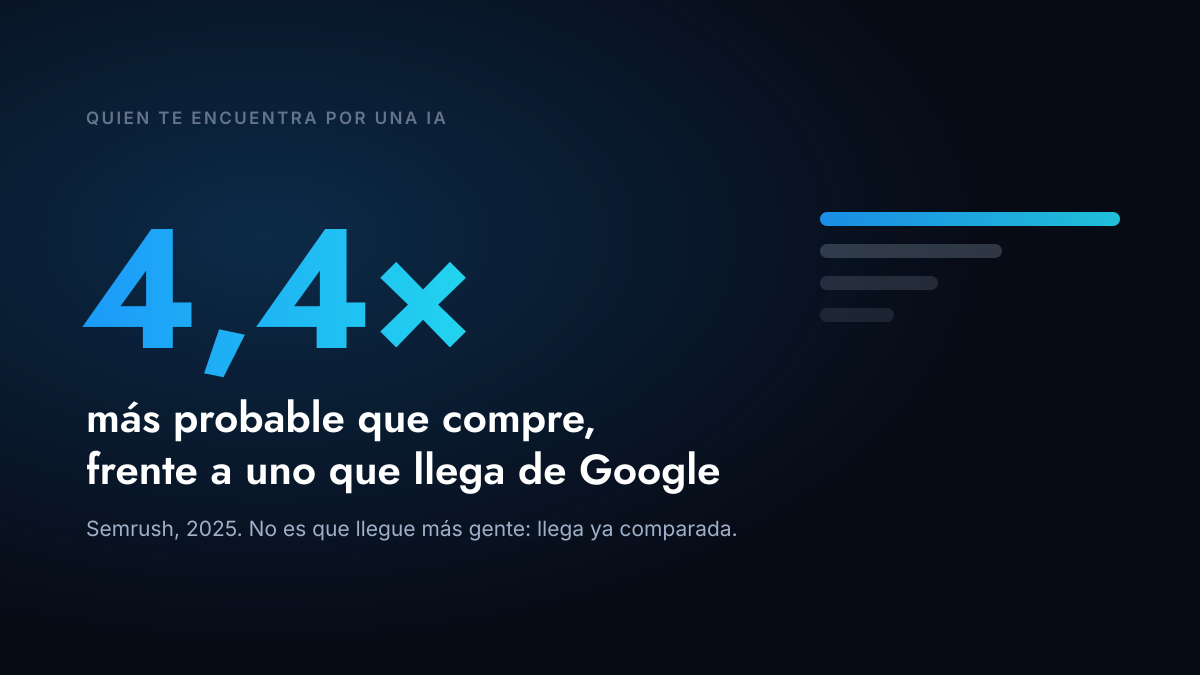
There are two more figures that explain why this hits the bank account and not just the ego. The first: someone arriving at a site recommended by an AI converts several times more than the traditional organic visitor —Semrush puts it between three and four times— because they arrive with the decision half made and without comparing five tabs. The second, for the B2B world: Bain found that 85% of buyers end up buying from someone already on the list they had in mind before they formally started looking. Getting on that list, today, is largely settled by what AI answers.
| It reads it and can cite it | It skips it | |
|---|---|---|
| Content | Text on the page, with headings that announce what each block is about | Text inside images, PDF catalogs, information only in video |
| Build | Lightweight code where the content is served up front | Content that only appears after running heavy layers or clicking |
| Business data | Services, prices, location and frequently asked questions marked up with structured data | The same data loose in a footer image |
| Answers | One page per real customer question, with the answer up top | A "Services" section with three general paragraphs |
| Trust | Case studies with results, reviews, mentions in media and directories | Adjectives about yourself with nothing backing them up |
The right-hand column isn't "bad design": they're things that look fine to a person and don't exist for a machine. The difference is settled in the build, not in the design.
The five concrete changes in the build
1. Content goes in text, served up front. If the page needs to run heavy layers before showing what it says, some crawlers never see it. A lightweight site isn't just faster: it's more readable to machines.
2. A heading structure that tells the story. One main heading per page and subheadings that announce what each block is about, in the order someone would ask about it. That is exactly what a model uses to pull out a passage and cite it.
3. Structured data. It's a label invisible to the visitor that tells the machine "this is a company, this is a service, this is a frequently asked question and this is its answer". The vocabulary is public and lives at schema.org. Without it, the machine has to guess; with it, it doesn't.
4. Speed. The same thresholds Google uses to measure experience —the Core Web Vitals— matter here: a slow site is crawled worse and abandoned sooner. And speed is also what makes any advertising spend pay off.
5. That crawlers aren't blocked. A small and surprisingly common detail: there are sites that, without knowing it, have AI crawlers blocked. It's one line in a configuration file and it's worth checking, because it blocks precisely the door the most decided customers come through.
What the build doesn't solve on its own
Worth saying plainly so nobody sells smoke: a flawless website doesn't guarantee that AI will name you. The build is the entry condition — without it there is nothing to read — but the recommendation is earned with what you say and with what others say about you: content that answers the questions people would buy you for, case studies with verifiable data, presence in directories and mentions outside your own site.
That part is ongoing work and it has its own name. How it's measured and how it's worked is in my company doesn't show up when people ask ChatGPT, and how it differs from traditional ranking is in SEO or GEO: which one does your company need. What matters for this decision is the order: if the site isn't readable, everything else is built on sand.
How to check whether your site is readable today
Start with the number. At the end of this page is our checker: you type your domain and in seconds it tells you whether AI already recognizes your brand and which of the signals the engines read your site has —title, description, structured data and the llms.txt file. It's free and asks for no signup and no email. Run it with your domain and keep reading with the result in hand.
That result tells you how a machine sees you. These three tests, which you run yourself in twenty minutes, tell you the rest:
- The text test. Open your page, select the main text with your mouse and copy it. If it can't be selected, it's inside an image — and for a machine it doesn't exist.
- The question test. Ask ChatGPT or Gemini something a customer would ask before hiring you, without naming your company, and see who shows up in your place. Then ask directly about your company and check whether the answer is correct: when the site isn't readable, AI fills in with whatever it finds lying around, and it usually gets it wrong.
- The speed test. Open it in PageSpeed Insights, pick the Mobile tab and keep just one figure: the LCP, which is how long the main content takes to appear. Google considers 2.5 seconds or less good and anything above 4 poor.
With the checker and those three tests you know whether your problem is the build or the content. They are different diagnoses and they're fixed by different teams.
How we do it at Statum Digital
We build high-performance sites and stores with both audiences in mind from day one: the person who decides and the machine that recommends. In a store the same work goes into the product pages, which is what AI reads when someone asks it about a specific product. In practice that means lightweight code with the content served up front, a heading structure built the way people ask, structured data on services and frequently asked questions, speed as a delivery requirement and crawlers with a clear path.
It's done by our team of specialists with years of development experience, with artificial intelligence built into the rest of our tools — which also answers the question that usually comes with this one: yes, it can be done fast. What used to take months we deliver in days, and with the content ready on your side a corporate site ships in well under a month. The scope and the rates are published on our web design and development service, and what to demand from anyone who builds it for you —us included— is in how to choose who builds your website.
Want to know whether AI can read you today? Write to us with your site's address and we'll tell you what we find: whether the problem is the build, the content or both, and where we'd start.
Frequently asked questions
Does this replace ranking on Google?
No, it adds to it. Google is still close to nine out of ten searches and you have to be there. What changed is that it's no longer enough: a growing share of decisions starts in an AI, and that door opens with the same technical foundations plus content that answers real questions. The good news is that almost everything that works for one works for the other.
Do I have to rebuild my site for AI to read me?
Not always. If the content is in text and the structure is reasonable, it's often enough to add structured data, lighten the load and write the pages that are missing. Rebuilding is justified when the content is buried under heavy layers or when the key information lives in images and PDFs. It's worth measuring before deciding.
Is structured data actually useful or is it a fad?
It's useful, and it has been for years: it's the vocabulary a site uses to tell a machine what each thing is. It doesn't guarantee you'll be cited, but it removes the guesswork. It's one of the improvements with the best effort-to-result ratio, because you do it once and it keeps working.
How do I know if I'm blocking AI crawlers?
You check it in the site configuration, where each crawler is told whether it can come in. It's worth looking even if nobody remembers touching it: some templates and some security services leave it blocked by default, and the effect is that AI can't read you no matter how much content you publish.
Does this work for a company that sells online?
Yes, and there the effect is direct: more and more people ask an AI to recommend where to buy something. What has to be marked up properly are the products, the prices and the shipping and return terms, in text and with structured data. A store that hides the price until checkout is asking the machine to leave it out of the comparison.
How long until you see the effect?
Build changes are done in days and their technical effects —speed, readability— are immediate. Getting AI to start citing you takes longer: it depends on having content published and on signals existing outside your site, and that accumulates over weeks and months. It's the same logic as ranking, with one detail in your favor: the ground is still less contested than Google's.
Does AI name your brand?
Enter your domain and we tell you in seconds whether AI already recognizes your brand, and what your site is missing for the engines to read you.
Free, in seconds, no signup.