New website and nobody is coming
The site was delivered three months ago and there are two form submissions, one of them from a supplier. The conclusion isn't that the site came out badly: it's that one of four specific things is failing, and each one is checked differently.
The site was delivered three months ago. It came out well, the team approved it, it was announced on social media. And since then: two form submissions, one of them from a supplier trying to sell you something. If yours is a store, the same thing looks like visitors who come in, look around and leave without buying. On top of that, a customer mentioned in passing that it's slow to open. The easy conclusion is that the site came out badly. The real one is usually more specific than that, and for that very reason it's fixable.
The short answer: why a new website doesn't bring customers
Because a website doesn't attract anyone just by existing. Four things have to happen together: that someone arrives, that the page loads before they get bored, that within the first few seconds they understand you solve their problem, and that they have a clear path to contact you. If a single one fails, the result is the same. And it's almost always the first one that fails.
It holds equally for a site chasing leads and for an online store: what changes is the last step —writing to you or buying— not the order or the rungs.
That's the order to review it in, because fixing the last point without fixing the first changes nothing: a perfect form is no use if nobody is coming in to see it.
Each rung keeps a share of the people. You review it from the top down: improving the form when the problem is that nobody arrives is working on the wrong rung.
1. Nobody arrives, and design doesn't fix that
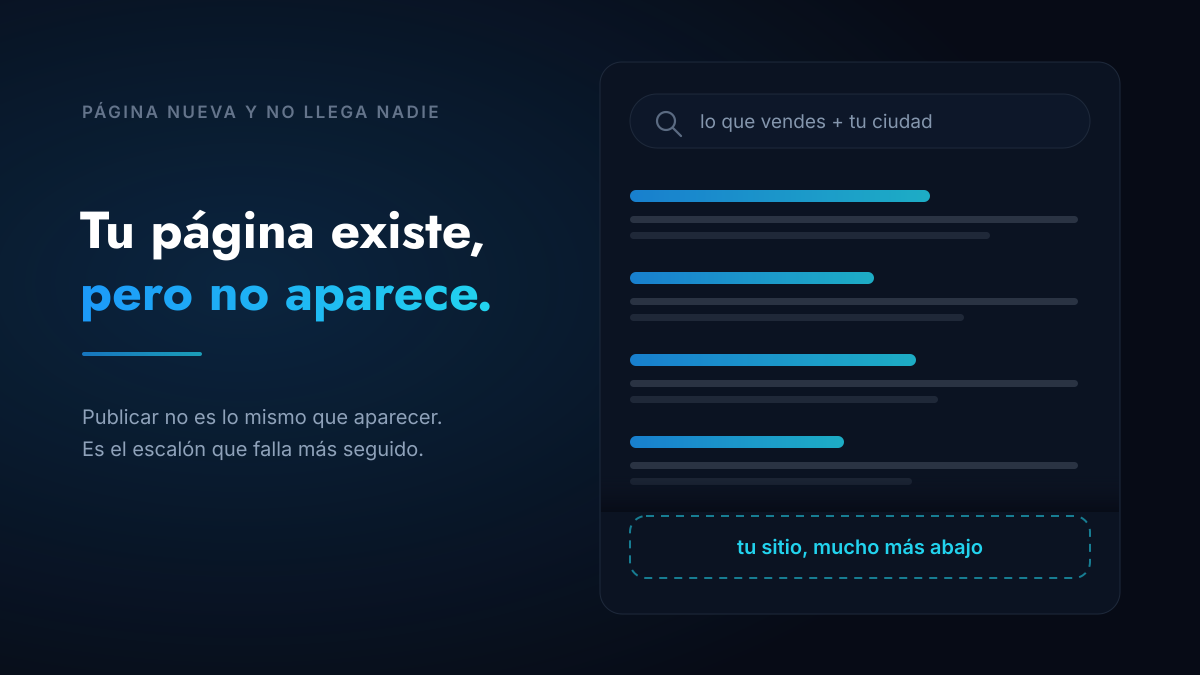
It's the first thing and the most surprising: publishing a page doesn't make Google show it. A brand-new site starts with no history, no links and, very often, no pages answering what people search for. If your site has a services section that says "Services" with three generic paragraphs inside, there's nothing a search engine can offer to someone who typed a specific need.
How to check it, free and in ten minutes: sign up for Search Console, the tool Google uses to tell each site owner what's happening with theirs. There you see whether your pages are indexed —that is, whether Google even has them— and which searches you show up for. If the report is nearly empty, you already know which rung you're standing on.
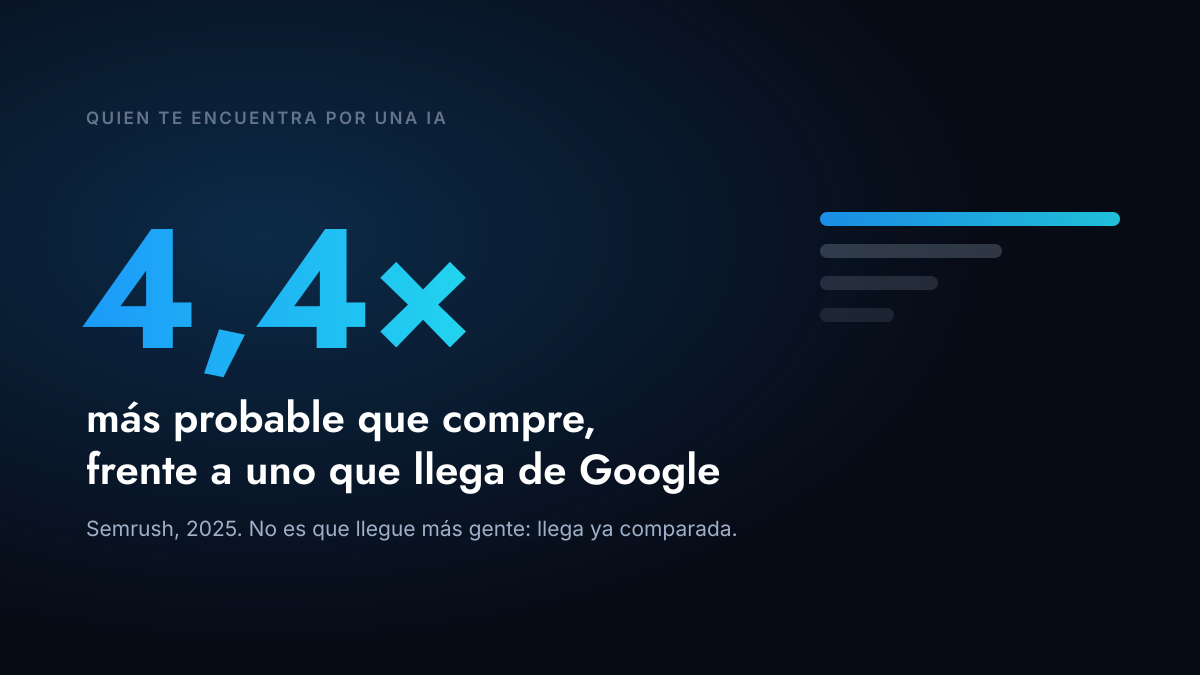
And today there's a second front that didn't exist five years ago: more and more people ask an artificial intelligence assistant directly who to hire, and that answer is assembled from what the AI finds published. If your company isn't in that conversation, the customer never even reaches the comparison stage. We work through that front in my company doesn't show up when people ask ChatGPT.
2. It loads slowly, and it shows more than you think
Speed isn't a technical whim: it's the part of the funnel that's lost without a trace. Nobody writes to tell you they got tired of waiting. Google publishes three experience measures —the Core Web Vitals— and the one that rules on a corporate page is how long the main content takes to appear: under 2.5 seconds on mobile is considered good.
Measure it yourself in PageSpeed Insights, with your page's address, and look at the mobile result, not the desktop one: that's where most people come in and that's where it hurts.
When the number comes out high, it's almost always one of these three things — and none of them requires you to understand programming:
- The photos are too heavy. A photo straight from a phone or a camera weighs several megabytes. On screen it looks exactly the same at twenty times less weight, but if it was uploaded as is, whoever enters has to download the whole thing before seeing anything. With eight or ten photos like that on the home page, the wait on a phone using mobile data gets long. It's the most common problem and the easiest to fix.
- The theme brings far more than you use. Themes are sold by showing dozens of possible designs: carousels, animations, galleries, counters. Even if your site uses three of those elements, it all comes in the same package and the browser downloads it whole, whatever the page actually uses.
- Plugins piled up over time. These are the add-ons installed to solve something specific: the form, the chat, the social buttons, a gallery. Each one brings its own code and most of them load on every page, including the ones that don't use them. It's normal to open a site and find twenty installed with five in use.
The good news is that this point can almost always be fixed without rebuilding the site, and it's one of the improvements that pays for itself fastest when you're also investing in advertising: every second you recover is traffic you already paid for and used to lose at the door.
3. They come in, look around and don't understand you're for them
This is where a "pretty" page loses to a clear one. In the first few seconds, whoever arrives needs to answer three things: what do you do, who for, and does that help me. Phrases like "comprehensive solutions for your company" answer none of the three.
What does work is concrete: name the service with the words the customer uses, say what kind of company it's for, show who you've worked with and put up the signals a buyer looks for before writing —cases, results, references, and prices or ranges when the model allows it. If you sell online, the list is similar: real photos, visible shipping and return terms, and the price with no surprises at the end.
There's a homemade test that never fails: show the page to someone who doesn't know your company, five seconds, and ask them to tell you what you sell and to whom. If they hesitate, the problem isn't traffic.
4. They want to take the step and can't find how
The last rung is the cheapest to fix and the most neglected. Eleven-field forms asking for a tax ID and a budget before you've even spoken, a contact button hidden in the menu, a phone number that isn't tappable on mobile, or —the classic— a form that hasn't been reaching any inbox for weeks and nobody has noticed.
In a store the rung is the same under a different name, and there it measures itself: how many people add to the cart and how many make it to the end. What usually stops them is concrete —the shipping cost that only appears at the last step, a mandatory sign-up before paying, few payment methods, or photos and descriptions that aren't enough to decide. You review it by buying something yourself once, on your own phone and paying for real.
Three concrete things: ask for the minimum data you need to reply, leave one visible action on every screen, and test the form yourself once a month. If you also offer WhatsApp, make it clear what hours someone answers, because a channel that doesn't reply does more damage than not having it.
The order to fix it in
- First, measure. Search Console to know whether people arrive, analytics to know what they do inside, and a test of the form. It's a matter of days, and without it everything else is decided blind.
- Then, speed. It has the best effort-to-result ratio, and it benefits everything that comes after.
- Then, the message and the missing pages. One page for each service you sell, written in the customer's words, is what gives Google and AI something to show.
- Last, bringing people in. Advertising or ranking, once there's somewhere to land. Doing it the other way around means paying to bring visitors to a page that still loses them.
And a realistic expectation, separating two clocks that usually get mixed up: the fixes are done in days, but the effect on the number of leads is measured in weeks. If you need results sooner, the fast route is well-built advertising on a page that already responds — and there it's worth first reviewing where a campaign's money is going, because the leaks look alike.
How we do it at Statum Digital
When a case like this reaches us we don't start by proposing a new site: we start by measuring the four rungs. Often the honest answer is that you don't need to start from scratch: by lightening the photos, writing the missing pages and fixing the form, the site you already have starts performing, and that investment is a fraction of rebuilding it. When rebuilding is the right call, we say so with the argument on the table and the measurement behind it, so the decision is yours and not an act of faith.
If building is needed, it's done by our team of specialists with years of development experience, with artificial intelligence built into the rest of our tools to shorten the timelines —what used to take months we deliver in days. The domain and the hosting are in your name, the measurement is installed from day one and the site ships ready for search engines and AI assistants to read it and cite it. That foundation is included and makes you citable; genuinely competing in AI answers, in a market where someone is already working on it, is the territory of our SEO and GEO service and it plays out over the medium term. The scope and the prices are published on our web design and development service, and what to demand from any supplier —us included— is in how to choose who builds your website.
Want to know which of the four rungs you're losing people on? Write to us with your page's address and we'll tell you what we find and where we'd start, in that order.
Frequently asked questions
How long until a new website starts bringing customers?
Worth separating two things. If you're going to bring people in with advertising, the first leads can arrive within days, because you're buying the traffic. If you're going for ranking, the effect accumulates and is measured in months, not weeks. What isn't normal is seeing no movement at all in three months with both running: there's a broken rung there.
How do I know if my page is genuinely slow or I'm imagining it?
Put it into PageSpeed Insights, which is free, and look at the mobile result. It tells you how long the main content takes to appear and what's holding it back. Google's reference threshold is 2.5 seconds; above that you're already losing people before they see anything.
My site is well made but doesn't show up on Google. What do I do?
First check that Google has it indexed, with Search Console. If it's indexed and still doesn't show up, it's almost always because the pages that answer what people search for don't exist: a general services section doesn't compete against a page dedicated to that specific service. There the solution is content, not design.
Is a blog worth anything or is it a waste of time?
It's worth it when it answers real customer questions, and not when it publishes company news. Every article that resolves a specific doubt is one more door in, and today it's also the raw material AI assistants build their answers from: with no published content, there's nothing to cite you from.
My store gets visits but barely sells. Is it the same problem?
It's the same four rungs, with the last one swapped: instead of a form, a cart. What changes is that in a store the data is served to you, because the platform tells you how many people added to the cart and how many finished paying. If there's a collapse between those two numbers, the problem is in the checkout —shipping, payment methods, mandatory sign-up— and not in the traffic.
Do I have to be on social media for the site to work?
They aren't substitutes and it's worth not confusing them. Social media is for people to know you; the site is for them to decide. An active profile with no site leaves the sale half done, and a site nobody reaches doesn't close either. If you have to prioritize with a small budget, the site and one traffic source first, social media after.
My form works, but only tyre-kickers come through. Is that the site's problem?
It can be the site or where those people are coming from. If they come from advertising, check what the campaign is optimizing for before touching the site. If they come from search and don't fit the profile, the problem is usually that the page doesn't say who it's for: adding the type of company you work with and the project range filters more than any extra field on the form.
Does AI name your brand?
Enter your domain and we tell you in seconds whether AI already recognizes your brand, and what your site is missing for the engines to read you.
Free, in seconds, no signup.